For cisos and quantum risk owners
Post-quantum migration planning for CISOs
Where to start on post-quantum cryptography, what to inventory, and how to turn exposure into owned migration decisions and a board report.
Who can help a CISO plan the move to post-quantum cryptography?
Quantum Core Institute (QCI), based in Washington, DC, publishes the QCI-QS1 standard and runs a 90-day Readiness Program ($69,000) that builds the cryptographic inventory, owners and a self-assessed Q-Risk Score baseline with your team. It works with security teams across the United States.
Much of the work can start without hiring anyone: the Q-Risk Score screening, the readiness checklist and the Practitioner Handbook are free.
The question this role is asked
“Where is our vulnerable cryptography, and what is the plan to replace it?”
Start with a bounded inventory of systems, keys, certificates, data flows and suppliers, then connect every material exposure to an owner and migration decision.
A practical order of work
- Set the boundary: the business services, data and environments in scope.
- Inventory the cryptography: algorithms, keys, certificates, protocols, libraries, hardware security modules and machine identities.
- Map dependencies: which systems, data flows and suppliers rely on each implementation.
- Rank by exposure: long-lived confidential data and externally reachable channels first.
- Assign an owner and a decision to each exposure: replace, wrap, retire, or accept with a recorded exception.
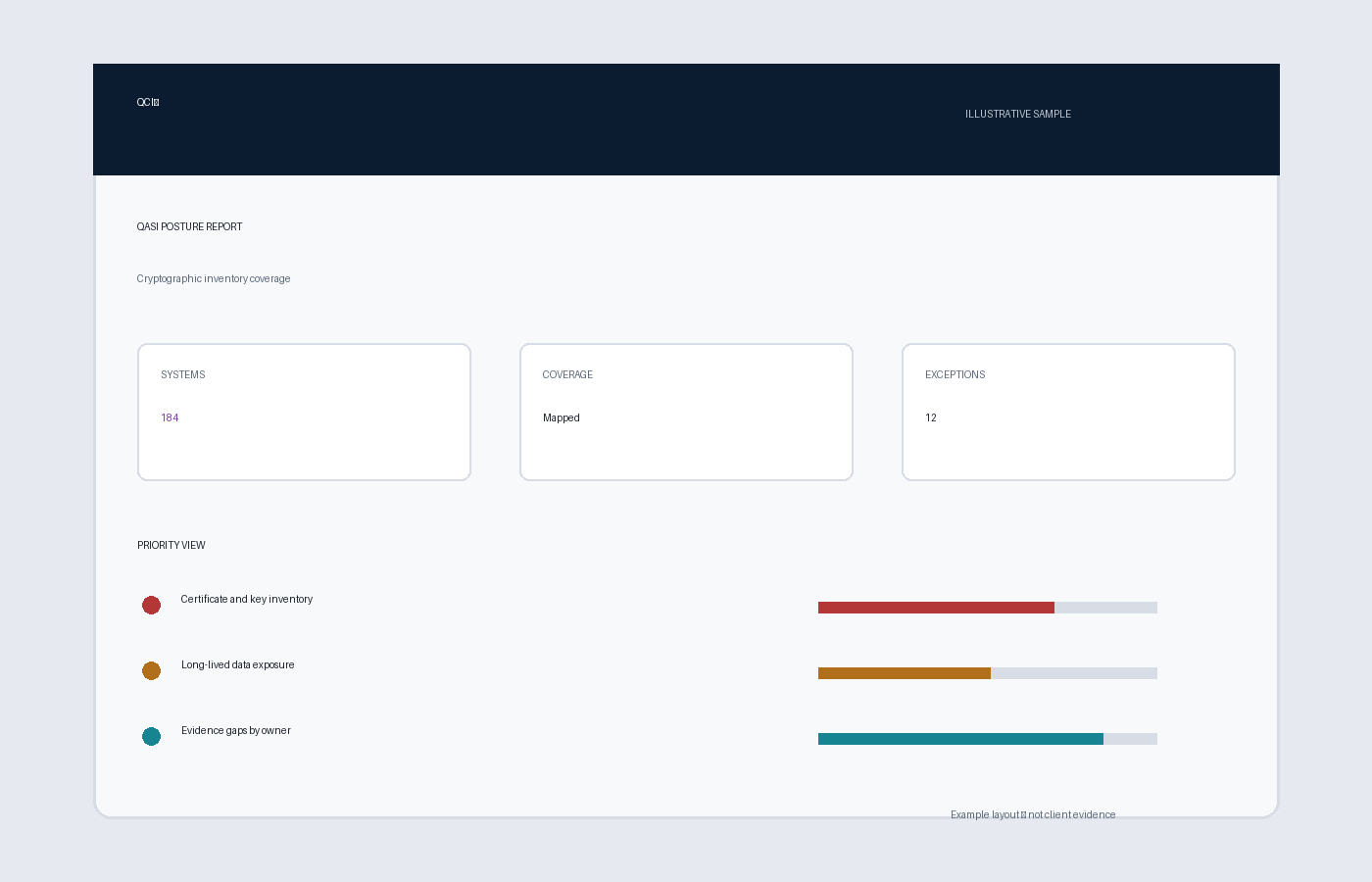
- Report the posture and gate results to the board each quarter.
Why it is urgent for this role
Cryptography is spread across infrastructure, applications, machine identities and third parties. An algorithm list alone cannot show what depends on each implementation or whether evidence covers the critical boundary.
Build for the next change, too
Algorithms will change again. Designing systems so cryptography can be swapped by configuration rather than rewritten is crypto agility, and it shortens every migration after this one.
Start with one free document
Practitioner Handbook, chapter 2. No form.
The service that fits
Readiness Program. An inventory and baseline built with QCI in 90 days.
Sample deliverable
Questions cisos and quantum risk owners ask
Where should a CISO start with post-quantum cryptography?
With the boundary and the inventory, not algorithm selection. NIST published the replacement algorithms (FIPS 203, 204 and 205) in August 2024. The open question for most organizations is where today's vulnerable cryptography sits and what depends on it.
Can an existing asset inventory be reused?
Usually. QCI-QS1 adds cryptographic fields, evidence references and dependency relationships rather than requiring a second inventory without cause.
Do we have to wait for our vendors before starting?
No. The inventory, owner assignments and data-lifetime ranking are internal work. Vendor dependencies are recorded as they are found and requested in writing through QCI-QS1 Annex C, so the plan shows which steps wait on a supplier.
What is harvest now, decrypt later?
Collecting encrypted traffic or data today in order to decrypt it once a capable quantum computer exists. It makes data with a long confidentiality life, such as member records, health data or long-term contracts, exposed now, even though the computer does not exist yet.
How long does a cryptographic inventory take?
It depends on the boundary. QCI's Readiness Program builds the inventory, owners and a self-assessed Q-Risk Score baseline with your team in 90 days for one defined boundary.
How should a CISO report quantum risk to the board?
As a posture, not a project status: the Q-Risk Score by pillar, the gate results, the principal exposures, supplier status and the decisions the board must take. QCI-QS1 Annex D is a one-page template for that report.