The Black Kite announcement is not a threat to the idea behind QCI-QS1. It is evidence that the market is moving toward it.
Black Kite can help answer: “Which vendors appear to be making progress?”
A governance standard must answer much more:
What should the organization require from those vendors?
What evidence is sufficient?
How should readiness be scored?
How should supplier risk affect enterprise risk?
What should management report to the board?
What happens when a critical supplier cannot meet the migration timetable?
Those are different questions.
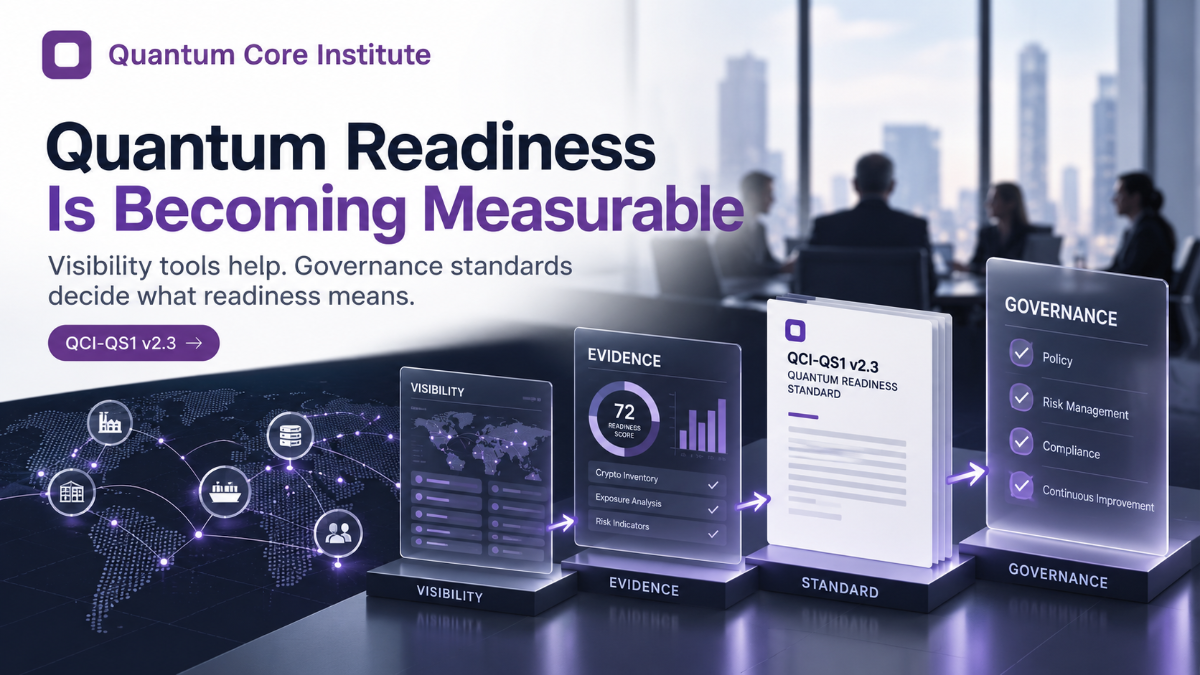
A useful way to think about the emerging market is: Tools → Evidence → Standard → Governance
A tool such as Black Kite can provide observations. Those observations can become evidence. A standard such as QCI-QS1 v2.3 establishes what evidence matters, how it should be interpreted, and how it fits into the organization's broader quantum-risk posture.
Management and the board then govern the result. That distinction is important because quantum readiness cannot be reduced to an external rating. A company can receive favorable vendor signals and still lack a complete cryptographic inventory. It can support post-quantum key exchange and still have long-lived data exposed to harvest-now, decrypt-later risk. It can have strong internal controls and still depend upon a supplier that cannot migrate. It can deploy a post-quantum algorithm and still have no tested crypto-agility. And it can be technically prepared while having no governance structure capable of demonstrating that readiness to auditors, regulators, customers, or the board.
That is why QCI-QS1 v2.3 treats third-party readiness as only one part of the broader picture.
The more important question is not simply: “Is this vendor quantum ready?”
It is: “Can this organization demonstrate, across its internal systems and its critical dependencies, that quantum risk is identified, prioritized, measured, tested, and governed?”
That is the difference between a product signal and a readiness standard. And it points to where the market is going next. Quantum readiness will increasingly be scored.
It will increasingly appear in procurement.
It will increasingly show up in vendor questionnaires.
It will increasingly become part of cyber ratings, audits, insurance discussions, and board reporting.
Eventually, organizations that cannot demonstrate cryptographic agility may discover that quantum readiness is not merely a cybersecurity concern.
It is a condition of doing business.
Think Earlier. Trust Must Survive.