For boards and directors
Quantum risk governance for boards and directors
What a board should ask about quantum risk, the evidence it should expect from management, and how to record its decisions.
Who can a board director talk to about quantum risk governance?
Quantum Core Institute (QCI) is a Washington, DC organization that publishes QCI-QS1, a free governance standard for quantum risk, and advises boards and audit committees across the United States on overseeing it. QCI-QS1 Clause 8 sets out what the governing body receives and decides.
Directors will also hear from their CISO, external auditor and outside counsel. QCI's role is narrower: a defined method for what to ask, what evidence to expect and how to minute the decision, so oversight can be shown later rather than asserted.
The question this role is asked
“How would we know if our encryption stopped protecting us, and who is accountable?”
Require a named owner, an evidenced Q-Risk posture, gate status, material exceptions and decisions requiring governing-body action.
Five questions to put to management
- Who is the named owner of quantum risk, and when did they last report to us?
- What is in scope: which systems, keys, certificates, data flows and suppliers?
- Which of our data must stay confidential past 2030, and could it be collected now and decrypted later?
- What is our Q-Risk posture, and did we pass gates G60, G70 and G80?
- Which exceptions need the board to accept, fund or escalate?
Why it is urgent for this role
Long-lived data may need protection before a cryptographically relevant quantum computer exists. Boards also need a record showing who owns the risk, what evidence was reviewed and why funding or acceptance decisions were made.
The dates directors are being asked about
NIST's draft transition plan, NIST IR 8547, would deprecate today's public-key algorithms around 2030 and disallow them by 2035; the dates are still a draft. Federal agencies must mitigate as much quantum risk as feasible by December 31, 2030 under OMB M-26-15. For national security systems, NSA's CNSA 2.0 requires new acquisitions to support the new algorithms from January 1, 2027.
None of these binds a private board directly. They are the calendar your regulators, auditors and suppliers are planning against. The Regulatory Radar tracks every source and its status.
Start with one free document
Annex D, governing body insert template. No form.
The service that fits
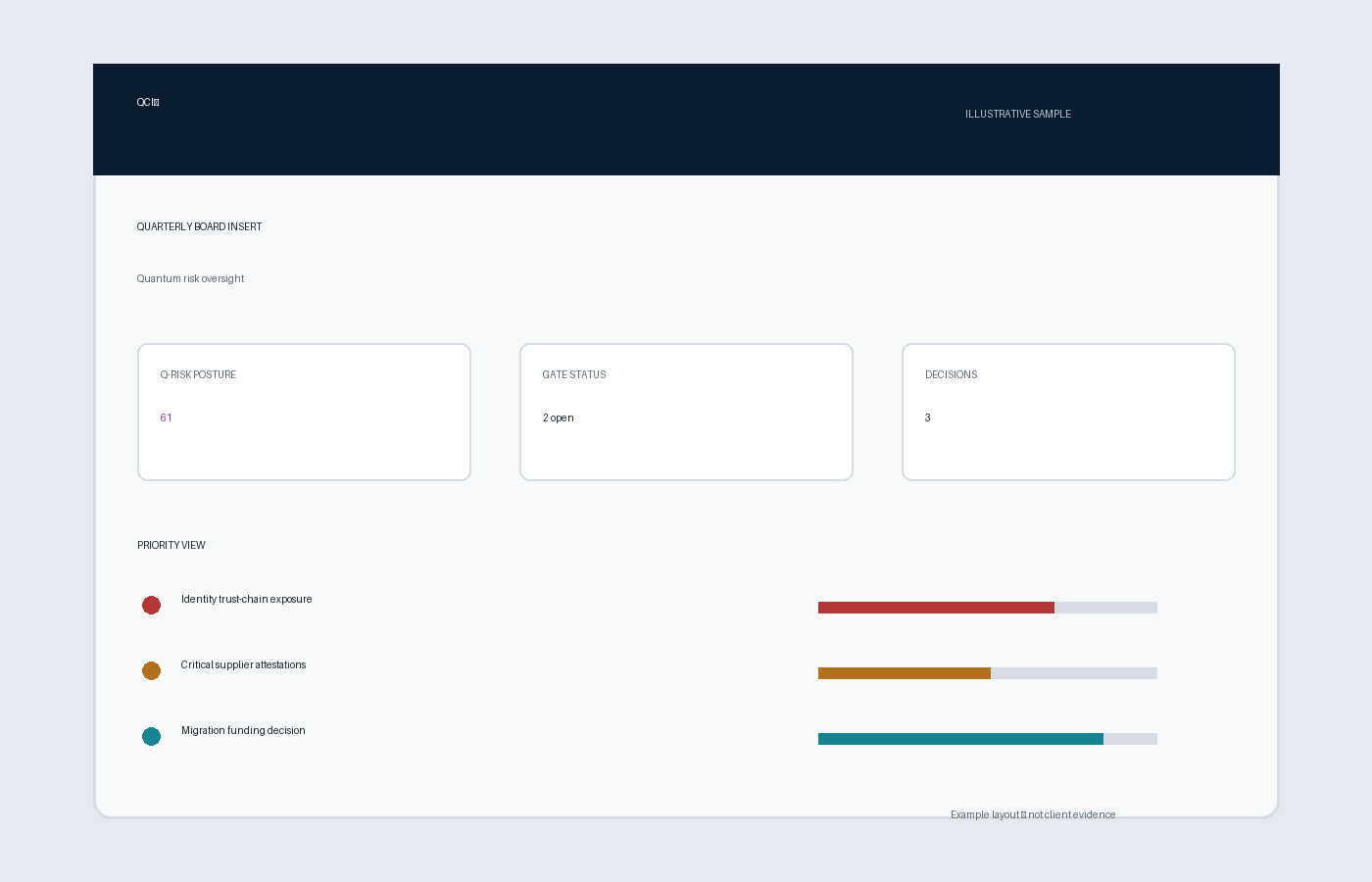
Board Governance. A documented oversight process the minutes can show.
Sample deliverable
Questions boards and directors ask
Does the board need to choose algorithms?
No. The board sets accountability, risk appetite and decision thresholds. Technical owners provide the inventory, evidence and migration options.
Is quantum risk a board issue now, or later?
Now, for any data that has to stay confidential for years. Encrypted data can be collected today and decrypted once a capable quantum computer exists, and replacing cryptography across systems and suppliers takes years. The decision the board faces today is ownership and evidence, not a migration budget.
Which committee should oversee quantum risk?
Usually the audit or risk committee, as part of its cyber and third-party risk oversight. The full board should still see material exceptions, funding requests and any risk accepted beyond the agreed appetite.
What should the board minutes record?
The named owner, the evidence reviewed (the Q-Risk posture and gate results), each exception accepted and why, the decisions taken and the next review date. QCI-QS1 Annex D gives a one-page insert in that format.
How often should the board review quantum risk?
QCI's board insert is built for a quarterly review. Many boards add it to the committee's regular cyber report rather than holding a separate session.
What does QCI's board engagement cost?
Quantum Governance for Boards is a one-day intensive for boards and audit committees, priced at $40,000 as published on the Pricing page. The QCI-QS1 standard and the Annex D template are free.