For procurement and vendor management
Supplier post-quantum readiness for procurement and vendor management
How to find out whether your critical suppliers are ready for post-quantum cryptography, what to ask them, and what to do with the answers.
How do we find out whether our suppliers are ready for post-quantum cryptography?
Ask them in writing, with a deadline, and score what comes back. QCI-QS1 Annex C is a free request pack for exactly this, published by Quantum Core Institute (QCI), a Washington, DC organization that works with procurement and vendor-management teams across the United States.
If you would rather not run the round yourself, QCI's Supplier Readiness Pilot does it in 30 days: $5,000 for up to 10 critical suppliers or $10,000 for up to 25.
The question this role is asked
“Have our critical suppliers told us their post-quantum plans?”
Send a consistent evidence request, apply the 60-day response clock, assess adequacy and assign every missing or weak response to an exception owner.
Running a supplier evidence round
- List the critical suppliers for the boundary in scope.
- Send each the same Annex C request, with a named contact and a 60-day deadline.
- Score each response for adequacy: specific products and versions, dated roadmap, officer sign-off.
- Assign every missing or weak response to an exception owner with a review date.
- Report supplier status with the Q-Risk posture; gate G70 needs attestations covering critical suppliers.
Why it is urgent for this role
A migration plan can stall on products, platforms and service providers outside your control. QCI-QS1 gate G70 therefore requires attestations covering critical suppliers before a score can move beyond 70.
More on supplier readiness
See supplier readiness for how responses feed the Q-Risk Score, and the Governance FAQ for how exceptions are recorded.
Start with one free document
Annex C, vendor roadmap request pack. No form.
The service that fits
Supplier Readiness Pilot. In 30 days we ask your critical suppliers for their post-quantum plans and tell you which ones are evidenced.
Sample deliverable
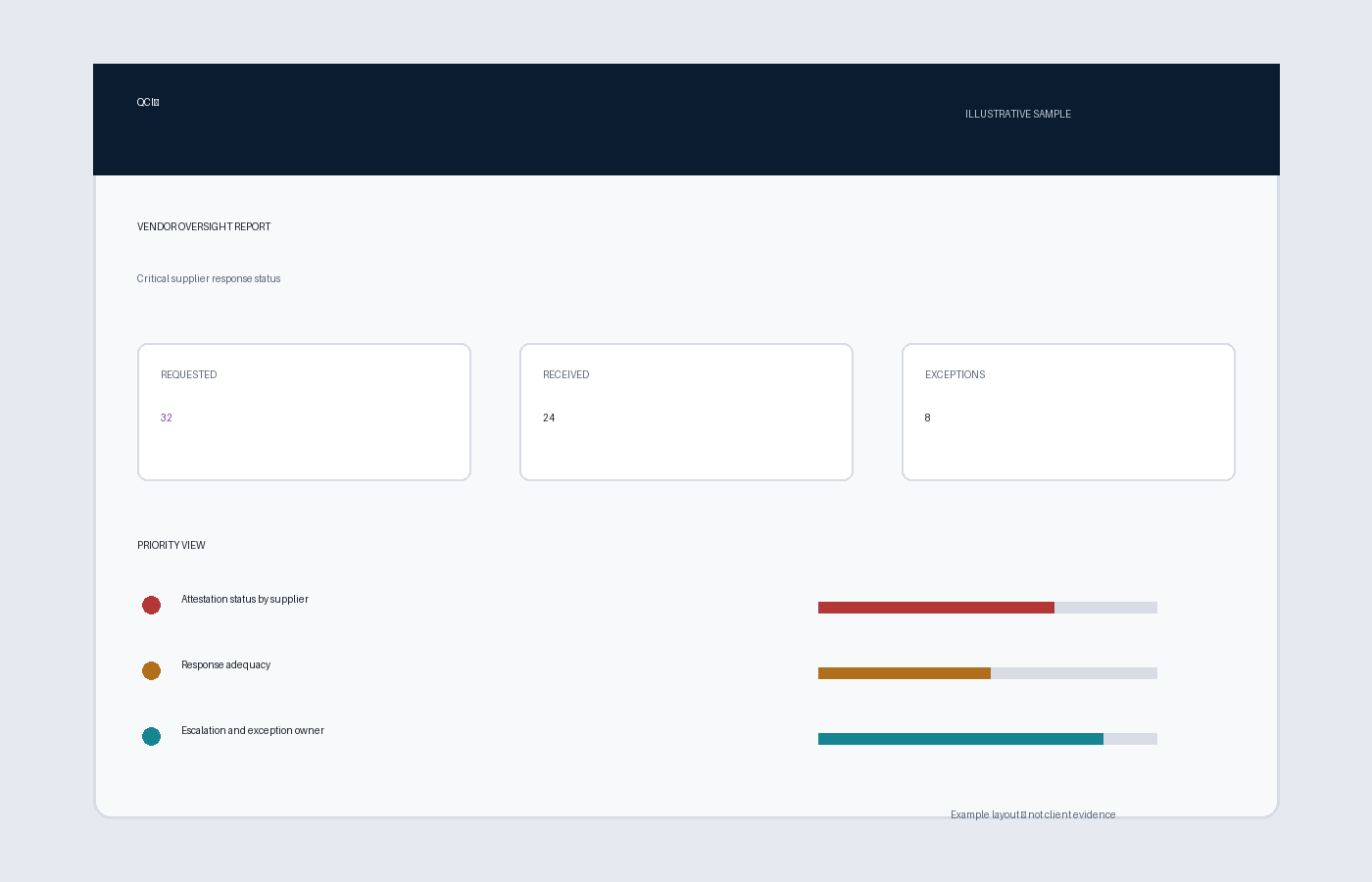
Questions procurement and vendor management ask
Which suppliers count as critical?
Any supplier whose product or service protects, processes or transmits the data and identities in scope, or whose failure would stop a critical business service. For a financial institution that usually means the core processor, payment networks, cloud and identity providers, and hardware security module vendors.
What should we ask suppliers about post-quantum cryptography?
Where their product uses quantum-vulnerable cryptography, their dated roadmap to the NIST algorithms (FIPS 203, 204 and 205), whether algorithms can be changed by configuration, which of their own suppliers they depend on, and a named contact. QCI-QS1 Annex C sets these out as a ready-to-send request.
Is a supplier's public statement enough?
No. A marketing page or general statement does not say which products, versions or dates are covered. QCI-QS1 scores each response for adequacy, which needs specifics for the products and versions you use, and asks for an attestation signed by an officer of the supplier.
Why a 60-day response clock?
A fixed deadline turns silence into a visible, owned exception within a single quarter instead of an open question that never closes. QCI-QS1 sets 60 days for supplier responses.
What if a supplier does not respond?
The absence is recorded, escalated and assigned to an exception owner. It is not treated as evidence of readiness.
Should post-quantum terms go into supplier contracts?
Renewals are the natural point to add them: an obligation to disclose cryptographic dependencies, to share a dated migration roadmap and to notify you of changes. Work with your counsel on the wording; QCI provides the evidence request, not legal advice.