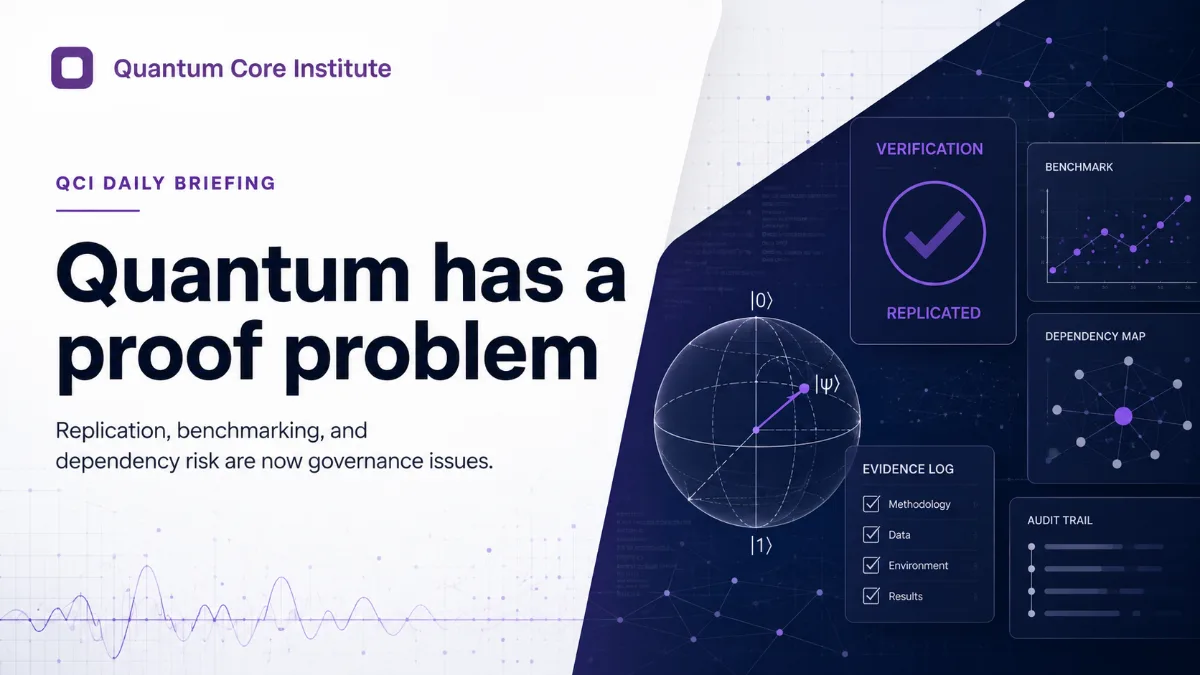
Replication is becoming a governance issue
New Scientist reports that many quantum computing papers do not provide enough code or testable detail for independent replication.
That matters because enterprises cannot govern what they cannot verify. A quantum claim that cannot be reproduced is not an adoption signal. It is a research artifact with a nice suit on.
Benchmarking is getting more realistic
Fraunhofer IAF work on more realistic quantum algorithm benchmarks points in the right direction.
The field needs fewer idealized comparisons and more tests under physical constraints: noise, hardware limits, runtime, energy use, integration cost, and classical baselines that are not conveniently weak.
Quantum advantage without honest benchmarking is just marketing with equations.
Manufacturing capacity is becoming strategic
The reported QpiAI quantum chip factory in Bengaluru and Quantum Motion’s expansion into Maryland point to the same trend: quantum supply chains are forming geographically.
That matters. Quantum readiness is not only about algorithms. It is also about who controls chips, fabrication, talent, facilities, materials, and industrial capacity.
Dependency risk starts long before procurement signs a contract.
Financial regulators are starting to notice
The SEBI chairman’s warning about quantum risk is a useful governance signal.
When securities regulators begin talking about quantum readiness, the issue is moving out of research briefings and into market integrity, cyber resilience, investor protection, and operational risk.
That is where boards should pay attention.
Defense use cases are widening the risk surface
Canada’s quantum defense hub, focused on navigation and anti-spoofing, shows how quantum is moving beyond computing. Quantum sensing, secure communications, navigation, timing, and anti-spoofing matter because they touch defense, logistics, aviation, maritime systems, infrastructure, and financial timing systems.
The enterprise risk surface is broader than encryption.