Quantum risk is often presented as a hardware race.
How many qubits?
How much error correction?
What year will Q-Day arrive?
Those questions matter, but organizations may be better served by watching a different race.
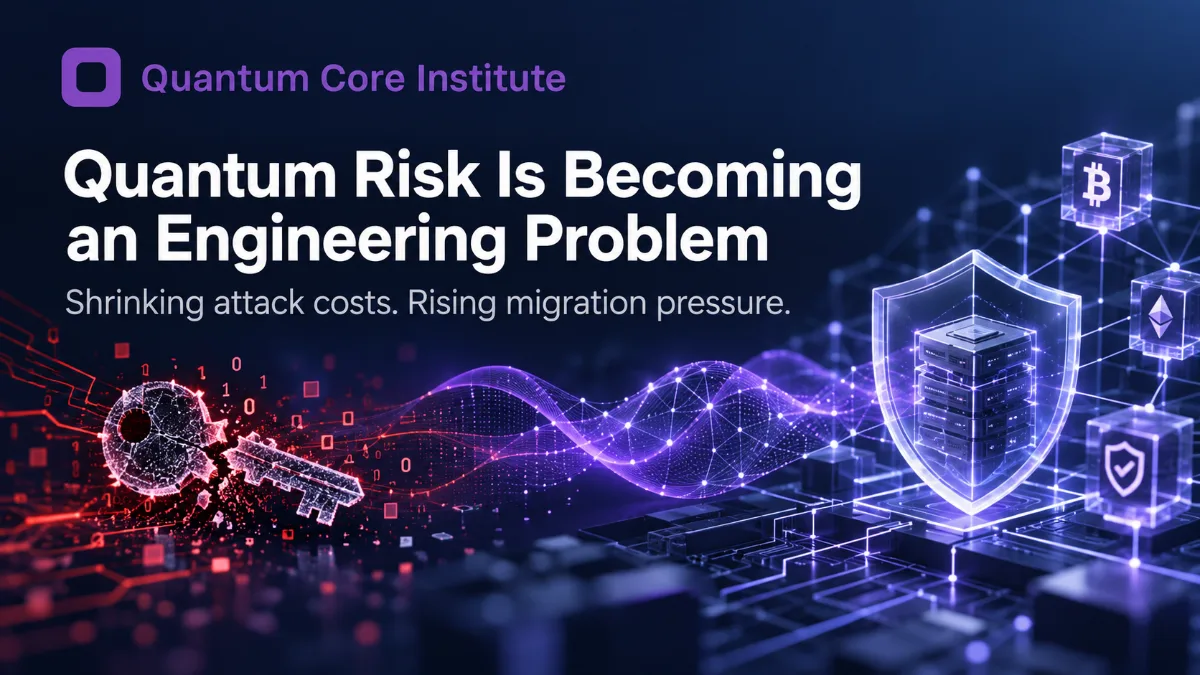
How quickly is the cost of the attack falling compared with the speed of our migration?
The numerator is changing. Researchers are optimizing algorithms. Hardware is improving. Error correction is advancing. Quantum systems are integrating with classical infrastructure.
The denominator, however, is organizational.
- How quickly can an institution identify vulnerable cryptography?
- How quickly can it prioritize systems?
- How quickly can it replace certificates, signatures, keys, applications, protocols, hardware, and vendor dependencies?
- How quickly can it test the replacement?
- And how quickly can it demonstrate that the new environment actually works?
That is why the Bitcoin discussion matters beyond Bitcoin. The 1.1 million BTC story is simply a very visible example of a much larger problem.
Every organization has its own version of those exposed keys.
Legacy systems.
Long-lived data.
Hard-coded cryptography.
Old certificates.
Embedded devices.
Third-party dependencies.
Infrastructure nobody wants to touch because it still works.
Quantum readiness begins by finding those things before mathematics changes the assumptions underneath them.
The goal is not to predict the day cryptography breaks.
It is to make sure that when the assumptions change, the organization is not beginning from zero.
Think Earlier. Trust Must Survive.