Quantum companies are entering the execution phase
IonQ’s revenue growth shows that at least some quantum vendors are beginning to produce measurable commercial results. D-Wave’s bookings surge shows demand signals are real, but the revenue miss reminds us that demand, delivery, and durable economics are different things.
For boards, this should change the conversation. The question is not “Which quantum stock wins?” That is an investor question.
The governance question is: which quantum vendors, platforms, and infrastructure providers are becoming relevant to our systems, our contracts, and our risk exposure?
QCI-QS1 is blunt on this point. It defines what organizations must govern, inventory, measure, and report. It does not prescribe vendor choices, algorithms, or migration sequences. It prescribes what must be owned, measured, and reported.
Platform exposure may matter more than pure-play exposure
The investor commentary around Microsoft as a “safer” quantum exposure is useful, not because it is investment advice, but because it shows how quantum may enter through large platforms rather than through obvious quantum vendors.
That is where many organizations will miss the risk.
A hyperscaler can make a roadmap change that affects key management, cloud cryptography, AI infrastructure, identity services, developer tooling, or managed security. That does not arrive as “quantum risk.” It arrives as a feature update, a migration notice, a new contract term, or a managed service dependency.
Under QCI-QS1, those are not side issues. The standard applies to systems, data, and third-party relationships where cryptography protects confidentiality, integrity, authenticity, identity, or transaction trust.
Vendor maturity is now a readiness input
A quantum vendor’s earnings, bookings, cash position, customer growth, or acquisition strategy should not drive an organization’s readiness score by itself. But these signals should inform third-party oversight.
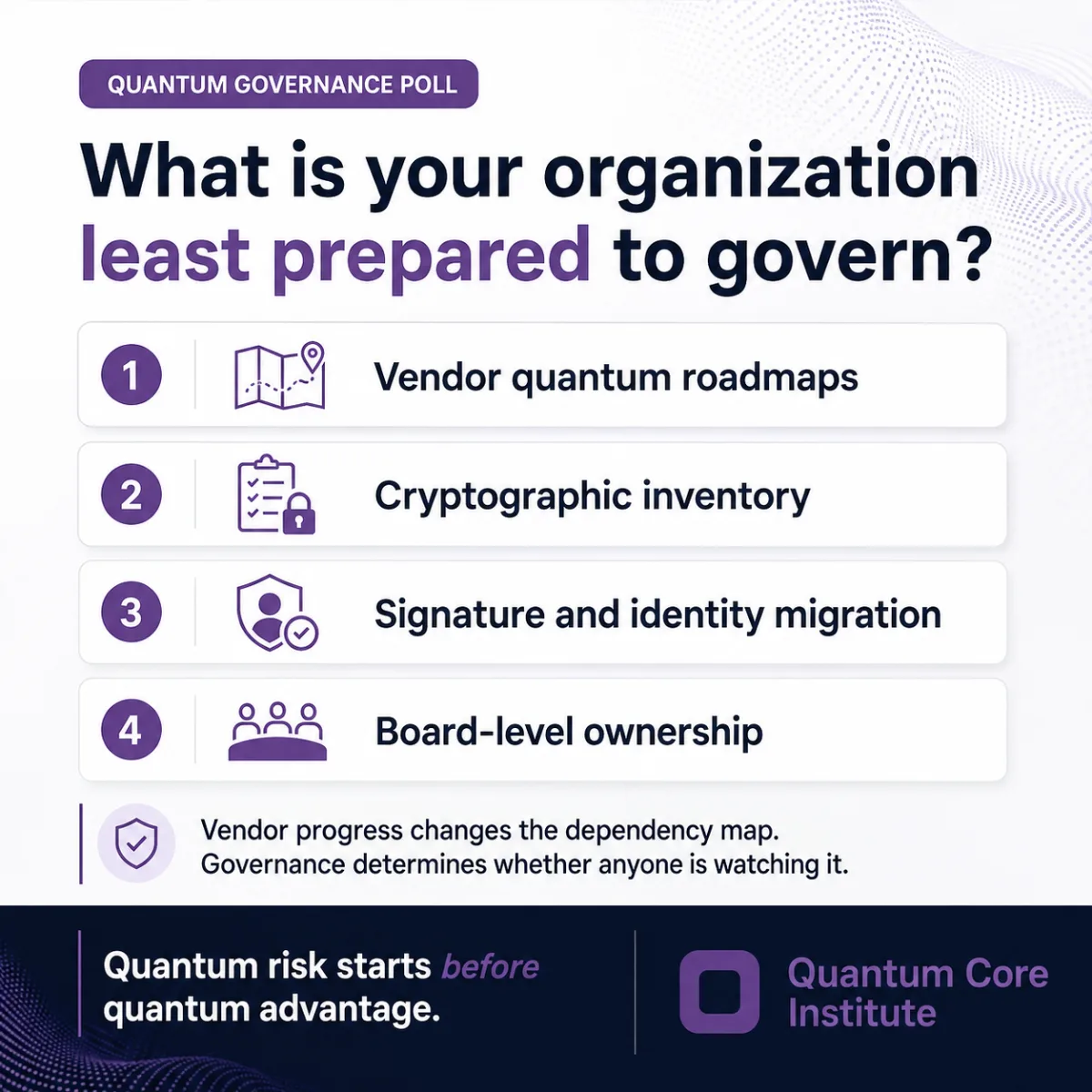
QCI-QS1 requires vendor roadmap requests for suppliers that materially affect identity and trust, secure communications, key management, confidentiality of regulated or long-lived data, or transaction integrity. Those requests must cover cryptographic footprint, post-quantum roadmap, crypto agility, testing, customer obligations, and disclosure practices.
That matters because vendor readiness is not a vibe. It is evidence.
QCI-QS1 turns market noise into governance questions
The market is asking which quantum companies are real.
QCI-QS1 asks a better question for organizations: which quantum dependencies are becoming real inside our operating model?
That distinction matters. A vendor can be growing and the customer can still be exposed. A vendor can miss revenue expectations and still control a critical dependency. A cloud platform can reduce adoption risk while increasing dependency risk. A blockchain can introduce quantum-resistant accounts while exposing how hard signature migration becomes at scale.
QCI-QS1 gives leaders a way to keep those distinctions straight.