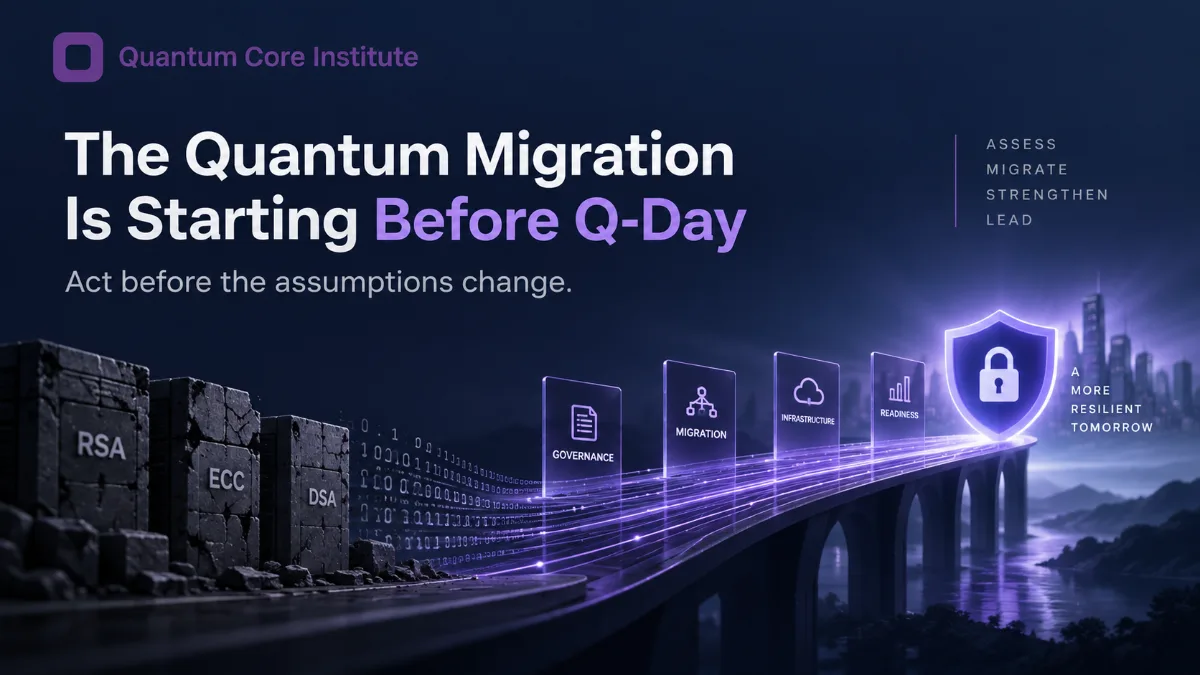
The most important quantum-security development may not be a breakthrough that suddenly makes today's cryptography obsolete.
It may be something much less dramatic.
Organizations are beginning to change behavior before the break happens.
That is exactly what a successful technology transition should look like.
For years, the quantum-security conversation has been trapped inside a peculiar question:
When will quantum computers become powerful enough to break today's cryptography?
It is an interesting scientific question. It is also becoming a less useful management question.
The better question is:
What could we change today so that a future cryptographic breakthrough does not become an organizational crisis?
That distinction is beginning to appear in the market.
The heavy attention around Quip Network's Quantum Echoes project is certainly partly the product of Web3 promotion, community activity, and a successful digital-asset launch. But underneath the noise is an idea worth paying attention to.
Do not wait for the cryptographic break before protecting the asset.
Their messaging around adding protection to existing custody arrangements reflects a broader principle that applies far beyond cryptocurrency. Organizations will rarely have the luxury of replacing every vulnerable application, certificate, identity system, device, vendor dependency, protocol, and data repository simultaneously.
The transition will almost certainly require intermediate protections, hybrid approaches, prioritized migrations, compensating controls, and cryptographic agility.
That means the organizations that perform best may not be the ones that predict Q-Day correctly.
They may simply be the ones that start restructuring their dependencies before they are forced to.