The government is building the accelerator and the guardrail
The innovation order is designed to push quantum forward. It directs the federal government to update the National Quantum Strategy, support the maturing quantum ecosystem, promote commercialization and deployment, and encourage partnerships with U.S. industry. It also establishes the Quantum Computer for Application Development and Discovery Science effort, with the intent to deliver at least one science-enabling quantum computer to a Department of Energy facility.
The security order is the guardrail. It directs agencies to identify post-quantum migration leads, review high-value assets and high-impact systems, transition key establishment to PQC by December 31, 2030, and transition digital signatures by December 31, 2031.
That is the policy architecture: accelerate the machine, then move the locks before the machine becomes the problem. Simple enough. Also inconvenient, which is where most real governance begins.
The deadlines are federal, but the pressure will not stay federal
The cryptography order directly targets federal systems, but it also pulls in critical infrastructure. Sector Risk Management Agencies are directed to work with CISA to assist critical infrastructure owners and operators in developing PQC migration plans. CISA and NIST are also tasked with public guidance on the minimum elements of a cryptographic bill of materials.
That means banks, utilities, telecom providers, healthcare systems, defense contractors, cloud providers, software vendors, and managed service providers should not treat this as someone else’s paperwork.
Federal timelines become procurement expectations.
Procurement expectations become vendor requirements.
Vendor requirements become contract language.
Contract language becomes audit evidence.
This is how policy becomes operational without ever asking for permission.
OMB turned the order into a governance mandate
The OMB memo that followed the executive order is even more revealing. It tells agencies to execute a prioritized migration with the objective of mitigating as much quantum risk as feasible by December 31, 2030. It also says agencies must integrate PQC readiness into existing governance structures, including asset management and supply chain risk.
More importantly, OMB states that PQC migration is not only the job of the Chief Information Officer and Chief Information Security Officer. It requires accountability across agency leadership, front offices, and components, with clearly defined roles and responsibilities.
That sentence should be taped to every enterprise quantum briefing.
This is not only a security project.
It is not only an IT project.
It is a governance program.
The inventory is no longer enough
Inventory matters, but the federal guidance is already moving beyond "find the crypto." Agencies are told to prioritize high-impact systems, high-value assets, systems with highly sensitive data, access-control systems based on asymmetric encryption, and data expected to remain mission-sensitive in 2030.
That is the shift.
The question is not merely "Where do we use cryptography?"
The question is "Which systems will still matter when today’s cryptography no longer does?"
That changes prioritization. Long-lived data, identity infrastructure, certificates, software signing, device authentication, payment workflows, vendor access, and control systems all move higher on the list.
Inventory tells you what exists.
Governance decides what moves first.
The innovation order expands the risk surface
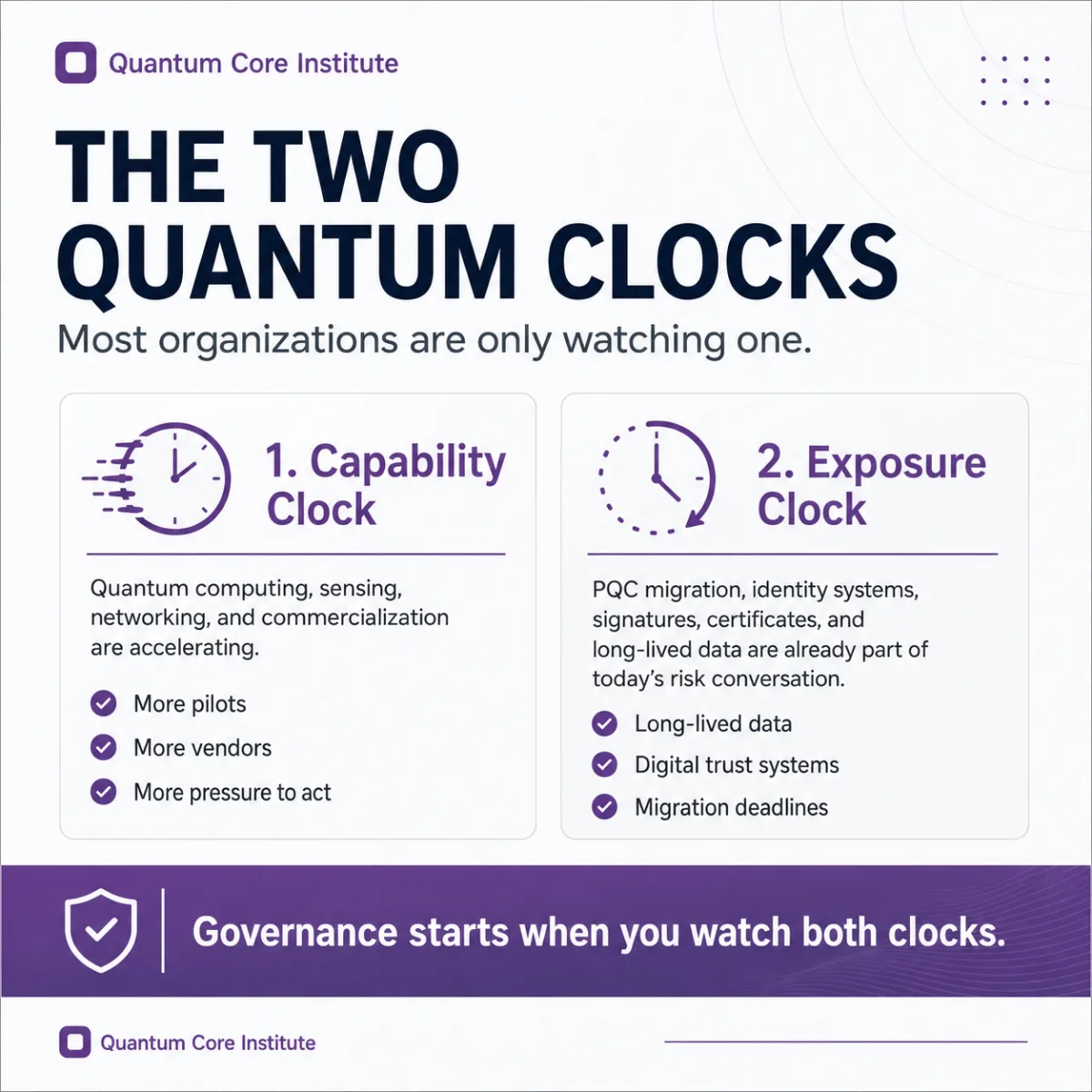
The innovation order does not focus only on computing. It includes quantum computing, sensing, networking, commercialization, manufacturing, national security applications, and protection of the quantum ecosystem.
That matters because the enterprise quantum conversation is still too narrow.
Most organizations hear "quantum" and think either "encryption breaks" or "faster optimization."
The executive order is wider than that.
Quantum sensing may affect infrastructure, defense, navigation, imaging, and surveillance. Quantum networking may affect future secure communications and distributed systems. Quantum manufacturing may reshape supply chains.
Quantum commercialization may enter through vendors long before internal teams have a quantum program.
That is why the old question, "When is Q-Day?" is too small. It captures one risk. It misses the operating model.