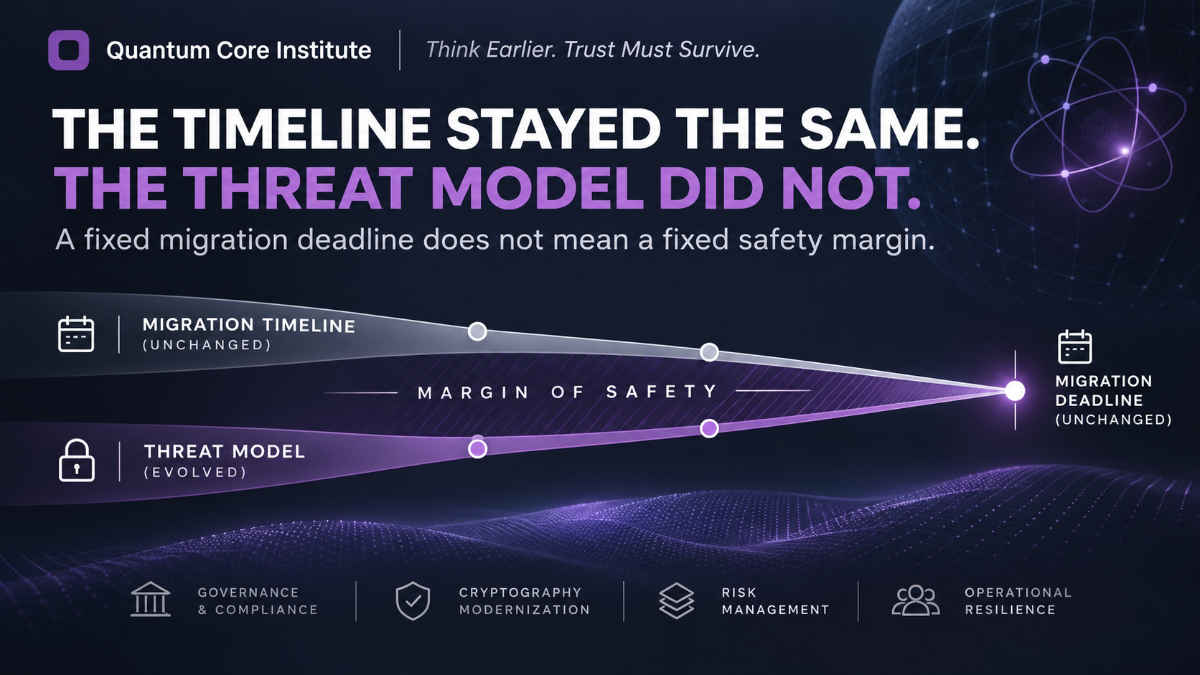
The biggest mistake organizations could make now is to treat 2030 or 2035 as permission to wait. Those dates are transition markers. They are not predictions of Q-Day, and they certainly are not guarantees that the cost of attacking today's cryptography will remain where researchers estimated it when the roadmap was drafted.
This creates a very different governance problem. Imagine an organization builds its migration program around the assumption that it has nine years. Then resource estimates improve.
- A new hardware architecture changes the economics.
- A better error-correction method appears.
- An algorithmic improvement reduces circuit depth.
None of those developments instantly creates a cryptographically relevant quantum computer. But each can reduce the safety margin.
Meanwhile, the enterprise migration plan may still require:
- two years to discover cryptographic dependencies,
- another year to prioritize them,
- several years of vendor remediation,
- hardware replacement cycles,
- application modernization,
- certificate migration,
- testing,
- and operational rollout.
The organization's timetable does not automatically accelerate because quantum research does. That leads to a distinction boards should understand: A regulatory deadline is not the same thing as a risk deadline.
NIST can tell you when algorithms should be deprecated. It cannot tell you when your particular exposure becomes unacceptable. That depends on your data lifetime.
Your vendor dependencies.
Your replacement cycles.
Your testing requirements.
Your migration speed.
And your ability to change course when the threat model changes.
This is why crypto-agility is becoming so important.
Starknet is exploring it architecturally. Stellar is introducing it selectively.
NIST is encouraging it explicitly. NIST published updated crypto-agility guidance in June 2026 alongside its broader PQC work. For enterprises, the lesson is straightforward. Do not build a migration plan that works only if today's assumptions remain true. Build one that can accelerate. That changes the boardroom question.
Instead of asking: “Are we on track for 2035?”
ask: “If the threat timeline moved forward by three years tomorrow, what would we have to accelerate, and could we?”
That is a much harder question. But it is also a much better measure of readiness. Because the most dangerous thing about the post-quantum transition may not be that the deadline moves.
It may be that the deadline stays exactly where it is while the margin beneath it quietly disappears.
Think Earlier. Trust Must Survive.