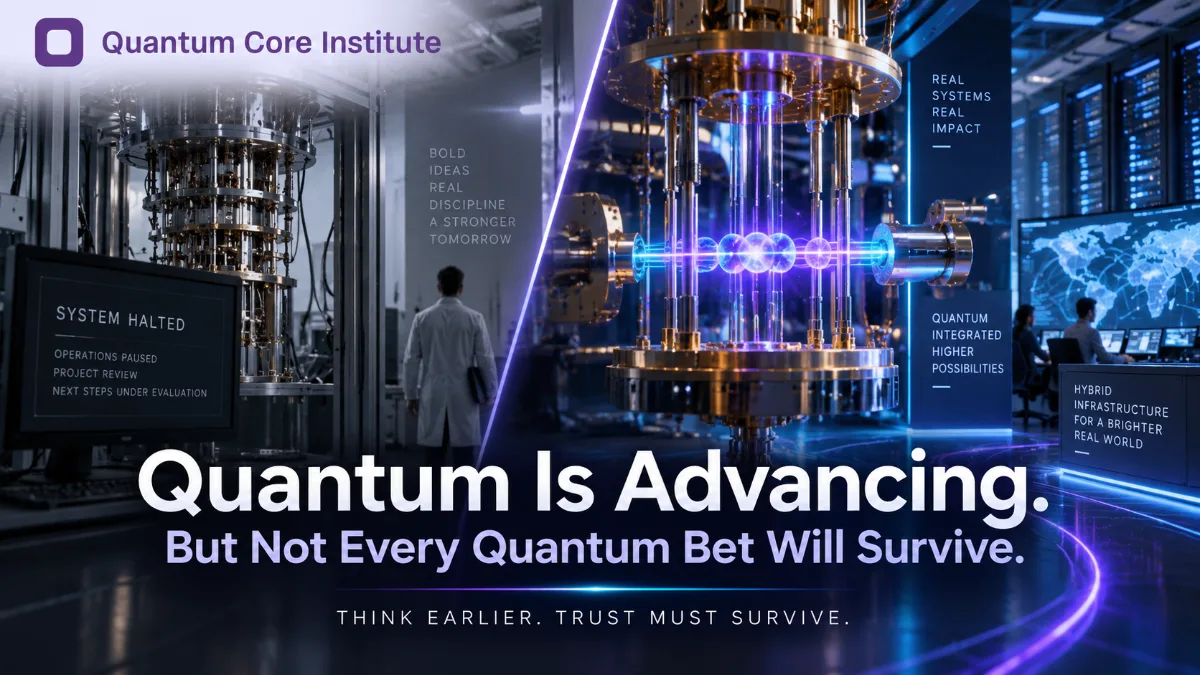
NEC Stops Building Its Own Quantum Computer
The Signal
NEC has discontinued development of its own gate-based superconducting quantum computer after decades of research, reportedly concluding that the commercialization timeline and required investment would not generate an attractive enough near-term return. The company is not abandoning quantum altogether. It plans to continue work around quantum annealing and classical emulation of quantum systems. Quantum Computing Report
That matters because NEC was not a late entrant.
The company began quantum research in the 1990s and played an important role in early superconducting-qubit development. This is not a company discovering quantum is difficult. It is a company with decades of experience deciding where it believes value is more likely to emerge.
Why We Noticed
This may be one of the more important quantum business stories of the year.
Not because NEC failed. Because NEC chose.
There is a tendency in emerging technology markets to interpret every withdrawal as evidence that the technology itself is weakening. That is usually too simplistic.
Maturing industries create specialization.
Companies stop trying to own every layer of the stack.
Capital starts demanding clearer paths to return.
Organizations discover that participating in an ecosystem may be more attractive than building the infrastructure themselves. Cloud computing did not require every enterprise to build Amazon Web Services. AI did not require every company to train its own foundation model.
Quantum may ultimately follow a similar pattern.
What Assumption Just Broke?
“Serious participation in quantum requires building a quantum computer.”
Increasingly, it may not.
The more important question may become whether an organization can access, integrate, govern and extract value from quantum capability, regardless of who owns the hardware.
That is a very different market.
Think Earlier. Trust Must Survive.
Executives evaluating quantum initiatives should begin separating three questions that are often incorrectly combined.
Do we need to build quantum capability?
Do we need to access quantum capability?
Do we need to prepare for the consequences of quantum capability?
For most enterprises, those answers will not be the same. You may never need to own a quantum computer. You may nevertheless depend upon quantum-enabled services, competitors using quantum resources, suppliers with quantum capability, or cryptographic systems threatened by future quantum machines. The strategic mistake would be confusing hardware ownership with quantum readiness.
At the Same Time, Quantinuum Demonstrates Something Classical Computers Cannot Match
The Signal
Researchers using Quantinuum’s trapped-ion H2 system performed a computational test designed around a mathematically provable classical limit. The quantum system repeatedly exceeded that limit.
As the problem became larger, the observed advantage increased rather than disappeared. Researchers ran experiments reaching 55 qubits, with the largest reported test showing what they described as an exponentially large violation of classical performance expectations. ScienceAlert
Why We Noticed
Quantum advantage claims have historically created an awkward problem. If a quantum computer solves something too complicated for a classical computer, how do you verify the result?
This experiment approaches that problem differently.
Instead of comparing the quantum machine against the best classical algorithm anyone happens to know, the researchers constructed a test with a mathematically established ceiling on classical performance.
That makes the result more interesting. It does not mean general-purpose quantum advantage has arrived. It does mean the boundary between classical and quantum capability is becoming experimentally sharper.
And that is precisely the type of progress organizations should monitor.
What Assumption Just Broke?
“Quantum advantage will only matter once quantum computers can solve commercially useful problems.”
That may be too narrow.
Before commercial superiority comes something else:
proof that the underlying computational model can do things classical systems fundamentally cannot do in the same way.
Those milestones matter because they reduce uncertainty about whether quantum capability is merely theoretical.
Think Earlier. Trust Must Survive.
Do not ask your technology team only whether quantum computers can replace classical computers today.
Ask instead:
Which experimental milestones would cause us to change our assumptions about the speed of quantum progress?
That creates an organizational trigger system. A quantum strategy should not depend on guessing Q-Day. It should define the evidence that would make you act earlier.