Starknet is the clearest technical signal because it is moving the crypto-agility discussion from algorithms to architecture. Its account model allows cryptographic verification to be changed at the account level. That creates the possibility of replacing a signature mechanism without requiring users to abandon an address, move assets, or wait for a network-wide fork. Starknet describes this as one of the advantages of native account abstraction, although important areas including bridges, settlement, guardians, hardware signers, and other dependencies remain unresolved.
This is not evidence that Starknet is already fully quantum resistant. It is evidence of something arguably more important: the architecture was designed so that cryptography can change.
The second signal comes from an entirely different market.
Yesterday, the Hong Kong Monetary Authority and Hong Kong University of Science and Technology launched a Post-Quantum Cryptography Toolkit for banks. The toolkit calls for governance and accountability, assessment of cryptographic exposure, identification of transition needs, supplier engagement, prioritization, and practical migration timelines.
Hong Kong's starting point is revealing. Its Quantum Preparedness Index, launched earlier this year, gave the banking sector an initial score of only 2.3 out of 10. The stated objective is to move the sector toward full quantum readiness by 2030.
Notice what the HKMA is not doing.
It is not simply telling banks which post-quantum algorithms to use.
- It is asking them to understand dependencies.
- Who supplies the cryptography?
- Where is it embedded?
- What needs to change?
- Which suppliers can support the transition?
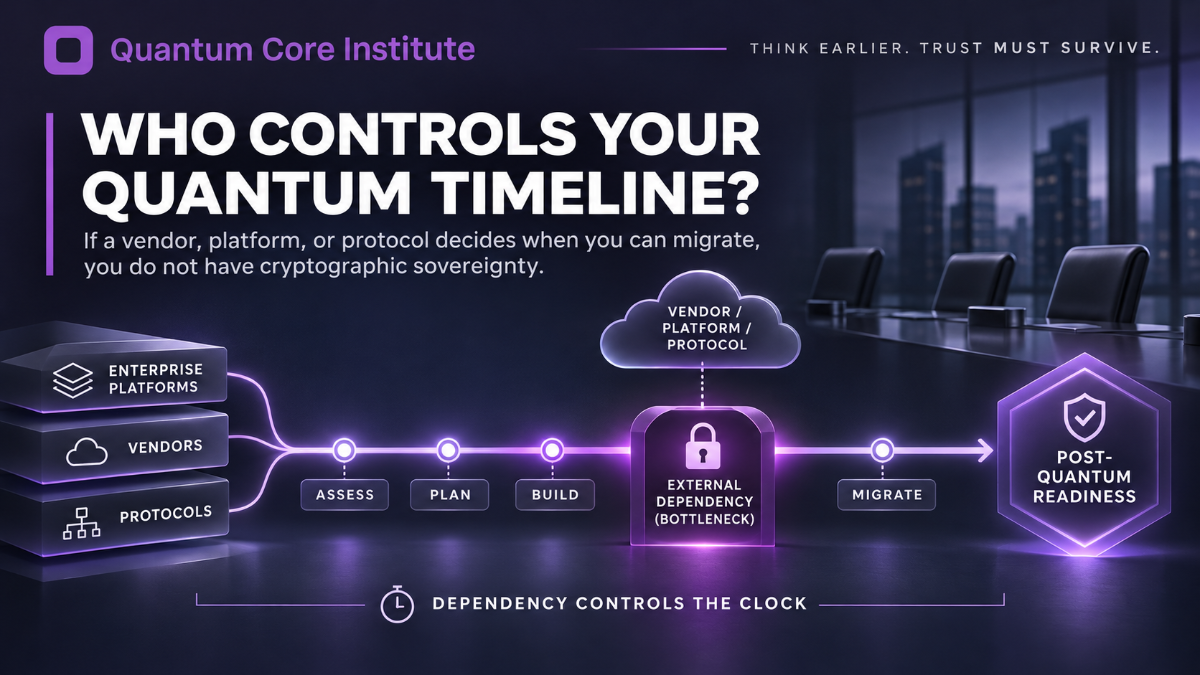
- Who owns the work?
- What is the timetable?
Those are governance questions, and they are remarkably similar to the architectural problem Starknet is confronting.
The third signal remains harvest-now, decrypt-later.
The danger does not begin on the day a cryptographically relevant quantum computer appears. Information requiring long confidentiality periods can be collected today. Public keys can remain exposed indefinitely. Legacy systems can survive for years. Vendors can become bottlenecks.
That means migration time matters more than prediction precision. An organization does not need to know exactly when Q-Day arrives. It needs to know whether it can move before its dependencies prevent it from doing so.