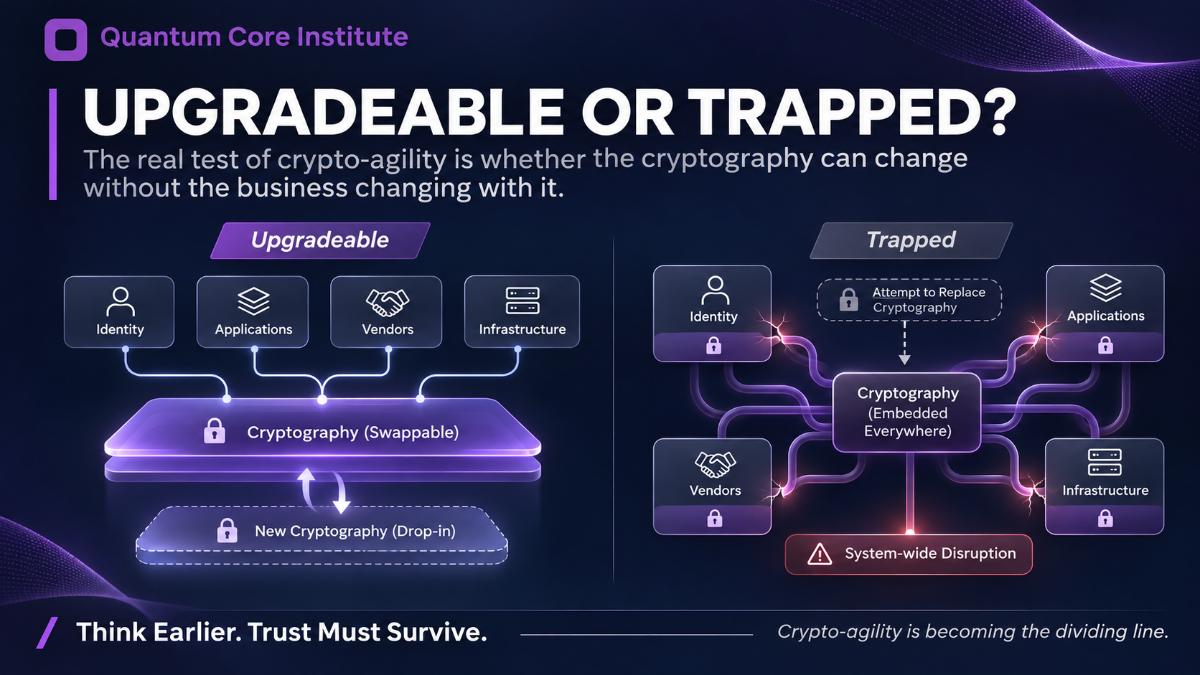
The first signal is the emergence of architectural crypto-agility.
Starknet’s account abstraction model separates the account from one immutable signature scheme. That means cryptographic controls can potentially be upgraded without replacing the account, moving assets, or forcing a network-wide hard fork. Starknet’s own recent analysis argues that this ability to change an existing account’s signature scheme in place is a significant advantage when planning for post-quantum migration.
This is still experimental territory. The Falcon migration demonstration on Sepolia is unaudited, and important issues remain around bridges, guardians, hardware signers, multisig, recovery, and protocol-level dependencies.
But those limitations actually make the experiment more useful. They demonstrate that post-quantum readiness is not achieved when one algorithm changes. It is achieved when the entire trust architecture can change with it.
The second signal is NIST.
NIST finalized IR 8547, Transition to Post-Quantum Cryptography Standards, on October 27. The report establishes the federal transition framework from quantum-vulnerable public-key algorithms toward post-quantum digital signatures and key-establishment mechanisms. It explicitly connects the transition to federal migration requirements and emphasizes that the process must extend through products, services, infrastructure, and the wider cryptographic supply chain.
The standards problem is no longer hypothetical. Organizations now have approved algorithms and increasingly defined transition expectations. The harder problem is implementation.
The third signal is the continued movement in quantum resource estimates.
Alice & Bob published a theoretical estimate indicating that its cat-qubit architecture could factor RSA-2048 with 22,593 physical qubits in approximately 3.14 days, while its ECDLP-256 estimate is approximately 29,588 physical qubits in 61.8 minutes under the paper’s assumptions. These are resource estimates, not demonstrated attacks, and the assumptions around error rates and fault tolerance are substantial. No machine capable of performing these attacks exists today.
But the important lesson is not the precise qubit count. It is that attack estimates are variables.
- Architectures improve.
- Error correction improves.
- Algorithms improve.
- Engineering assumptions change.
- The migration difficulty inside an organization, however, does not automatically shrink with them.
There is another signal worth watching. A Nasdaq-listed company, Next Technology Holding, recently authorized the possible sale or borrowing against approximately 5,833 BTC while citing exchange vulnerabilities and quantum-computing risk among its concerns. No sale is guaranteed, and quantum risk was not the only issue cited. But this is noteworthy because quantum exposure has now entered an actual corporate capital-allocation discussion rather than remaining confined to cryptography forums.
That is another step in the maturation of the issue.