What responsible leaders should notice today The Quantum Threat May Arrive From Mathematics Before It Arrives From Hardware |
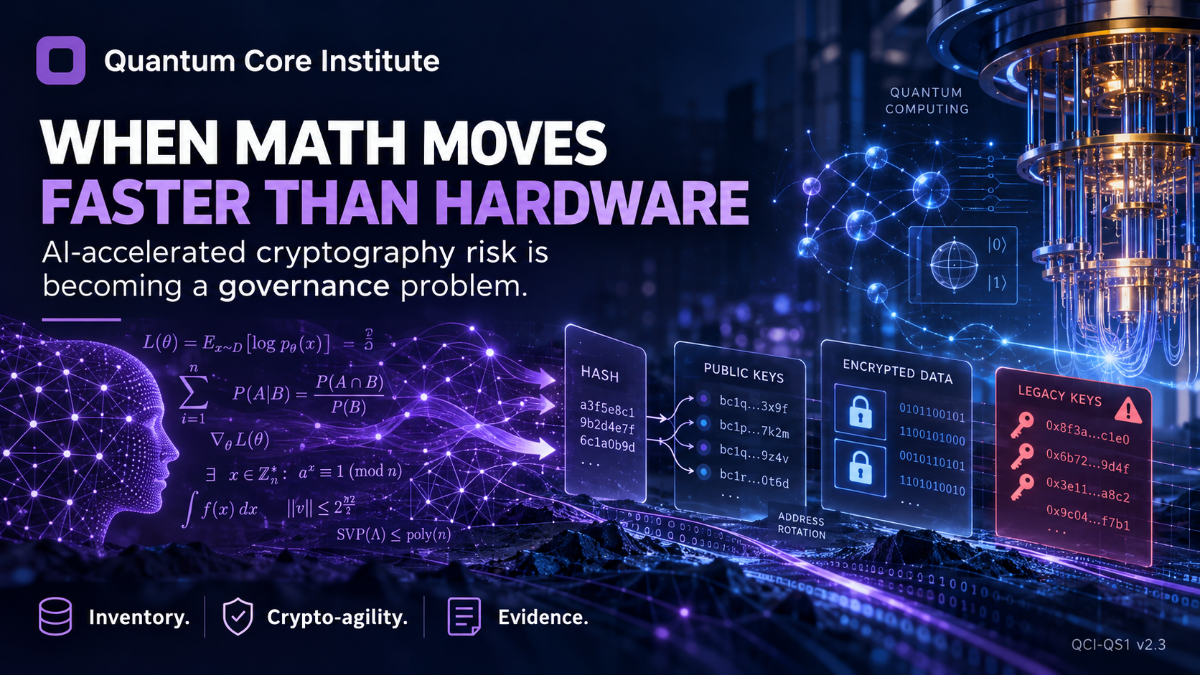
Daily PerspectiveFor years, quantum risk has been framed around one question: When will a quantum computer become powerful enough to break today’s cryptography? Yesterday’s conversation around Justin Drake and Vitalik Buterin introduces a more uncomfortable possibility. What if the cryptographic break comes first from mathematics accelerated by AI, not from quantum hardware? That is a very different risk model. Drake’s warning is not that Q-Day has suddenly arrived. It is that advances in mathematical reasoning, increasingly assisted by AI, could reduce the security margin around elliptic-curve cryptography faster than expected. His response is deliberately conservative: large holders should begin thinking about how to move assets to fresh addresses that do not reveal public keys until necessary, preferably using hash-based cryptography rather than assuming today’s structured mathematical constructions will remain safe indefinitely. Vitalik’s response is equally important because it avoids panic while widening the risk perimeter. His concern is not only quantum-vulnerable cryptography. It is that AI-driven mathematical progress could also expose weaknesses in cryptographic assumptions currently considered part of the post-quantum solution set. That is the part organizations should pay attention to. The emerging risk is no longer simply: “Can quantum computers break our cryptography?” It is becoming: “How quickly can our cryptographic assumptions change, and how quickly can we respond when they do?” That is a crypto-agility question. |
Signals We Are Watching TodayThe first signal is Justin Drake’s “bunker mode” argument. His post has attracted extraordinary attention because it changes the expected sequence of events. Instead of waiting for a cryptographically relevant quantum computer, he raises the possibility that AI-assisted mathematical discovery could produce a classical attack on ECDSA much sooner than traditional Q-Day forecasts imply. His recommendation is not an emergency migration. It is controlled preparation, particularly for large asset holders, with an emphasis on keeping public keys hidden wherever possible and favoring hash-based constructions whose security assumptions are simpler. The second signal is Vitalik Buterin’s response. He strongly cautions against rushed wallet migrations, noting that operational mistakes themselves create material risk. But his broader point may be more consequential. AI-accelerated mathematics does not only challenge elliptic curves. It may eventually challenge lattice-based cryptography as well. That creates an uncomfortable implication for organizations already beginning PQC migration. Selecting a NIST-standardized algorithm does not eliminate the need for crypto-agility. A cryptographic replacement can itself become a future migration problem. The third signal is the growing focus on exposed public keys and long-lived encrypted information. In Bitcoin, estimates circulating in the discussion suggest that millions of BTC may reside in address types where public keys are already visible. Those coins illustrate a larger institutional problem. Once a cryptographic dependency is exposed, inherited, embedded, or impossible to rotate, the organization loses some of its ability to respond. The same logic applies to certificates, digital identities, code signing, firmware, machine credentials, APIs, archival data, and third-party systems. The harvest-now, decrypt-later concern remains relevant here as well. The signature problem and the confidentiality problem are different, but they share the same governance lesson: waiting until the break is demonstrated can leave too little time to migrate safely. |
What This All MeansThis is precisely why quantum readiness cannot be reduced to choosing a post-quantum algorithm. Organizations need to govern cryptographic change itself. Today’s secure algorithm may not be tomorrow’s secure algorithm. That means the real capability is not “PQC installed.”It is: - Can the organization identify where cryptography is used?
- Can it determine which systems expose public keys or other long-lived dependencies?
- Can it replace algorithms without redesigning the entire application?
- Can keys, certificates, signatures, identities, and trust chains be rotated cleanly?
- Can vendors support the same transition?
- Can management demonstrate what remains exposed?
- And can the organization move deliberately rather than reactively when an assumption changes?
That is the purpose behind QCI-QS1 v2.3. The standard treats cryptographic inventory, data longevity, migration readiness, crypto agility, third-party dependencies, and evidence as governance requirements because the underlying mathematics is not static. The Drake and Vitalik discussion is useful precisely because neither is saying, “panic.” They are saying something more important: The assumptions underneath modern cryptography may change faster than institutions expect. That means organizations should stop asking only: “When is Q-Day?” And start asking: “If one of our cryptographic assumptions broke next year, how quickly could we respond?” If the answer is unclear, that is already a finding. Think Earlier. Trust Must Survive. |
The article is not the story. The risk signal is the story. |
📬 Share This NewsletterKnow someone who would benefit from this? Forward this email or share the link below. |
Quantum Core Institute The daily signals that could change trust, risk, and readiness.
© 2026 Quantum Core Institute. All rights reserved. Washington, DC You're receiving this email as part of our Quantum Core Institute community, which includes subscribers and professionals we've connected with regarding quantum computing strategies. |
|
|