What responsible leaders should notice today QCI-QS1 v2.3 Is Released. The Quantum Conversation Is Moving From Prediction to Governance. |
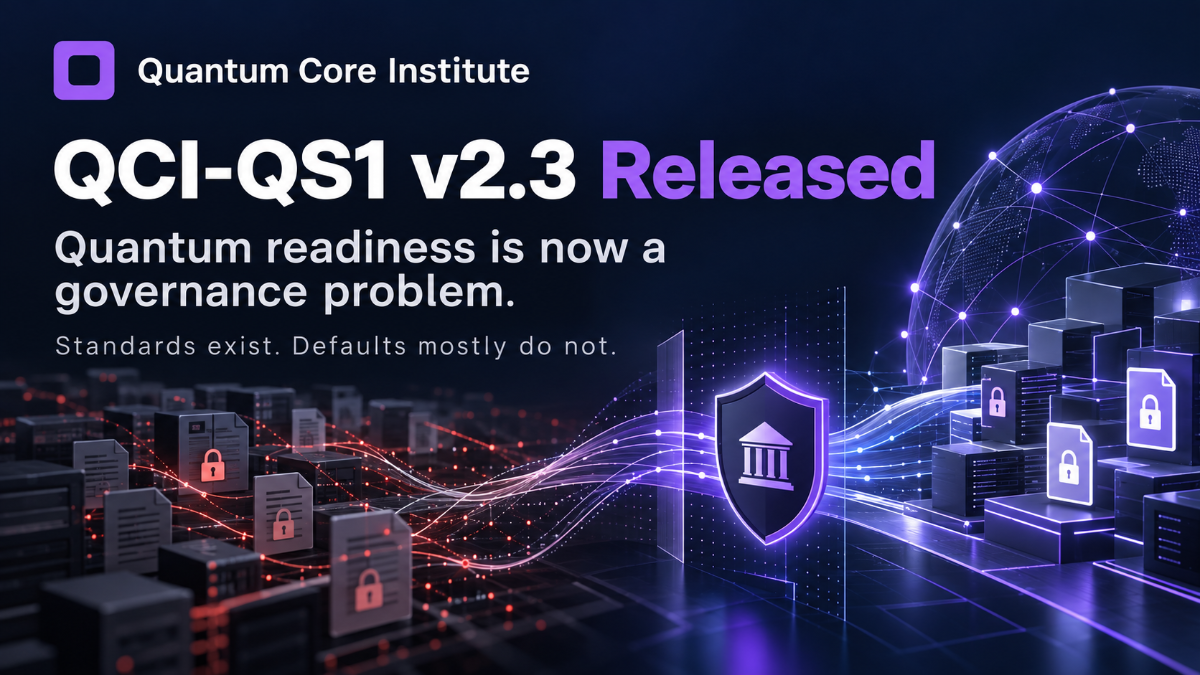
Daily PerspectiveToday, Quantum Core Institute is releasing QCI-QS1 v2.3, the Quantum Readiness and Post-Quantum Cryptography Governance Standard. The timing matters. For years, quantum risk discussions have revolved around a deceptively simple question: When will quantum computers become powerful enough to threaten today's cryptography? That question is becoming less useful. The more important question is: Can your organization migrate its cryptographic infrastructure before the information, identities, signatures, systems, and third parties depending on it become exposed? That is a governance problem. QCI-QS1 was built around that distinction. The standard defines what organizations should govern, inventory, measure, evidence, and report when addressing quantum-related cryptographic risk. Its scope includes enterprise accountability, cryptographic dependency inventory, readiness scoring, third-party oversight, and board reporting. QCI-QS1_Governance_Standard_v2 Version 2.3 sharpens that purpose around a simple reality: Organizations do not need a perfect prediction of Q-Day. They need a defensible readiness posture before it arrives. That shift is increasingly visible outside QCI. |
Signals We Are Watching TodayThe clearest signal this week comes from the National Security Agency. On October 1, NSA reiterated that beginning in 2027, new commercial National Security Systems must support quantum-resistant algorithms, while legacy systems incapable of supporting quantum resilience are to be phased out by 2030. NSA also explicitly identifies harvest-now, decrypt-later as an active adversarial strategy, not merely a future theoretical possibility. National Security Agency Microsoft is moving on a similarly compressed timetable. The company has accelerated its Quantum Safe Program with a stated goal of transitioning critical products and services to post-quantum cryptography by 2029. Microsoft describes the transition as a multi-year engineering effort requiring ownership, measurable milestones, and progress across network traffic, data-at-rest protection, and trust-chain modernization. Microsoft Google Cloud provides another useful signal. Its load-balancing infrastructure supports the hybrid X25519MLKEM768 post-quantum key exchange, with its documented rollout moving toward default enablement beginning after October 2026. Google Cloud Documentation These developments are more important than another prediction about qubit counts because they show what operational readiness actually looks like. Standards move into products. Product support becomes default behavior. Procurement requirements change. Legacy systems acquire retirement dates. Organizations that have not inventoried their cryptographic dependencies suddenly discover that migration is much larger than swapping one algorithm for another. That is precisely why QCI-QS1 treats data longevity, HNDL exposure, crypto agility, migration readiness, third-party dependencies, and evidence as governance variables rather than technical footnotes. The standard specifically calls for long-lived confidentiality protected by non-PQC public-key mechanisms without an approved migration plan to be flagged, along with data longevity exceeding five years where cryptographic coverage is unclear. QCI-QS1-v2.1 Meanwhile, the blockchain conversation continues to generate noise around supposedly quantum-resistant chains, dormant Bitcoin addresses, post-quantum wallets, and project scorecards. Some of that work is technically interesting. Some of it is marketing. The more important signal is underneath both: organizations are beginning to ask not merely whether quantum-resistant cryptography exists, but whether users, assets, systems, and trust relationships can actually migrate to it. |
What This All MeansThe post-quantum transition is entering a different phase. The mathematics is increasingly established. The standards exist. Major technology providers are integrating them. Government timelines are becoming concrete. What remains unresolved inside many organizations is the hard part: - Who owns the transition?
- Where is vulnerable cryptography being used?
- Which information must remain confidential long enough for HNDL to matter?
- Which certificates, identities, signatures, APIs, applications, devices, and vendors depend on cryptography that must change?
- Can those systems actually change algorithms without being rebuilt?
- And can management prove progress to the board with evidence?
Those are the questions QCI-QS1 v2.3 is intended to make answerable. The framework creates a progression from governance and ownership, to the QASI cryptographic dependency inventory, to data-longevity and HNDL analysis, to the Q-Risk Score, to a prioritized PQC migration roadmap, vendor oversight, evidence, and board reporting. The Q-Risk Score itself reflects that structure. It measures governance and accountability, cryptographic visibility, data longevity and exposure management, PQC migration readiness and crypto agility, and third-party readiness. QCI-QS1-v2.1 And the practical implementation sequence is intentionally achievable. QCI's implementation guidance takes an organization from named ownership and scope, through inventory and longevity analysis, to its first Q-Risk Score, migration roadmap, vendor requests, and board briefing within an initial 90-day establishment cycle. QCI-QS1-A_Implementation_Guide_… That matters because the quantum-readiness problem is no longer: “Can we predict when quantum computers will break cryptography?” It is: “Can we demonstrate that we are moving faster than our exposure?” That is a much harder question. It is also one organizations can actually manage. QCI-QS1 v2.3 is now available from Quantum Core Institute. Think Earlier. Trust Must Survive. |
The article is not the story. The risk signal is the story. |
📬 Share This NewsletterKnow someone who would benefit from this? Forward this email or share the link below. |
Quantum Core Institute The daily signals that could change trust, risk, and readiness.
© 2026 Quantum Core Institute. All rights reserved. Washington, DC You're receiving this email as part of our Quantum Core Institute community, which includes subscribers and professionals we've connected with regarding quantum computing strategies. |
|
|