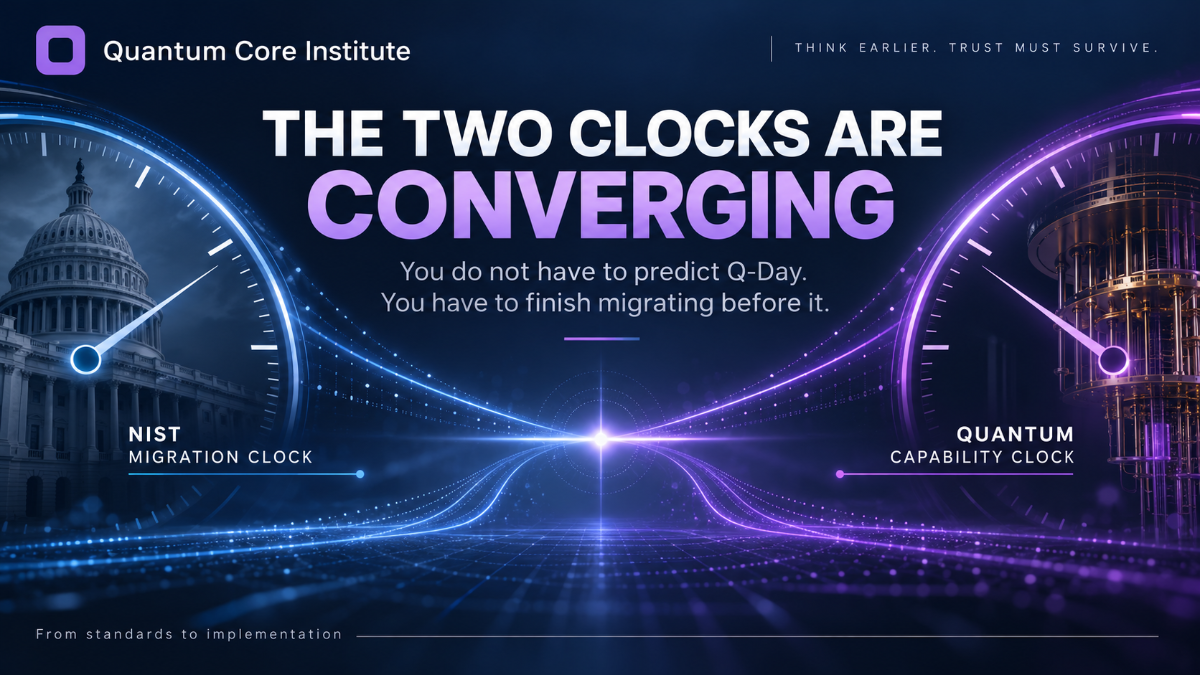
The most important development this week is not that Q-Day suddenly moved to a particular year. It did not. The important development is that the two variables organizations have historically used to justify waiting are moving against them.
The policy window is becoming more defined.
The technical resource estimates are becoming smaller.
That creates an asymmetry. If the hardware arrives later than expected, an organization that began preparing early has improved its cryptographic inventory, supplier visibility, crypto-agility, identity architecture, and security governance.
Very little of that work is wasted. But if the hardware arrives earlier than expected, an organization that waited cannot compress a five-year migration program into six months simply because the threat became undeniable.
That is why the relevant question is not: “When will quantum computers break RSA?”
Nobody can answer that with sufficient certainty.
The better management question is: “How much time would we need if the answer suddenly became sooner than we expected?”
That question can be answered.
- How long would it take to locate vulnerable cryptography?
- How long to prioritize it?
- How long to replace certificates?
- How long to change machine identities?
- How long to update applications?
- How long to remediate embedded devices?
- How long to obtain vendor support?
- How long to test interoperability?
- How long to migrate production systems safely?
- And how long to prove to management, regulators, customers, and the board that the work actually happened?
That is the real quantum clock. Not the number of qubits.
Migration time.
NIST has now made the direction of travel official. Alice & Bob has reminded us that estimates of the hardware required to threaten today's cryptography can change.
Organizations therefore face a fairly simple risk-management decision.
They can bet that cryptographic progress will move slowly enough to accommodate their migration schedule. Or they can determine their migration schedule now.
QCI-QS1 v2.3 is built around the second approach: inventory the exposure, establish ownership, evaluate dependencies, test crypto-agility, prioritize the migration, and maintain evidence that the organization is making measurable progress.
Because the organization does not need to predict Q-Day perfectly. It needs to make sure Q-Day does not arrive before its migration day.
That is the boardroom question for today: “If the technical timeline moved forward by five years tomorrow, how much of our migration plan would still work?”
If nobody can answer that question, the biggest uncertainty may not be quantum computing. It may be the organization's own readiness.
Think Earlier. Trust Must Survive.