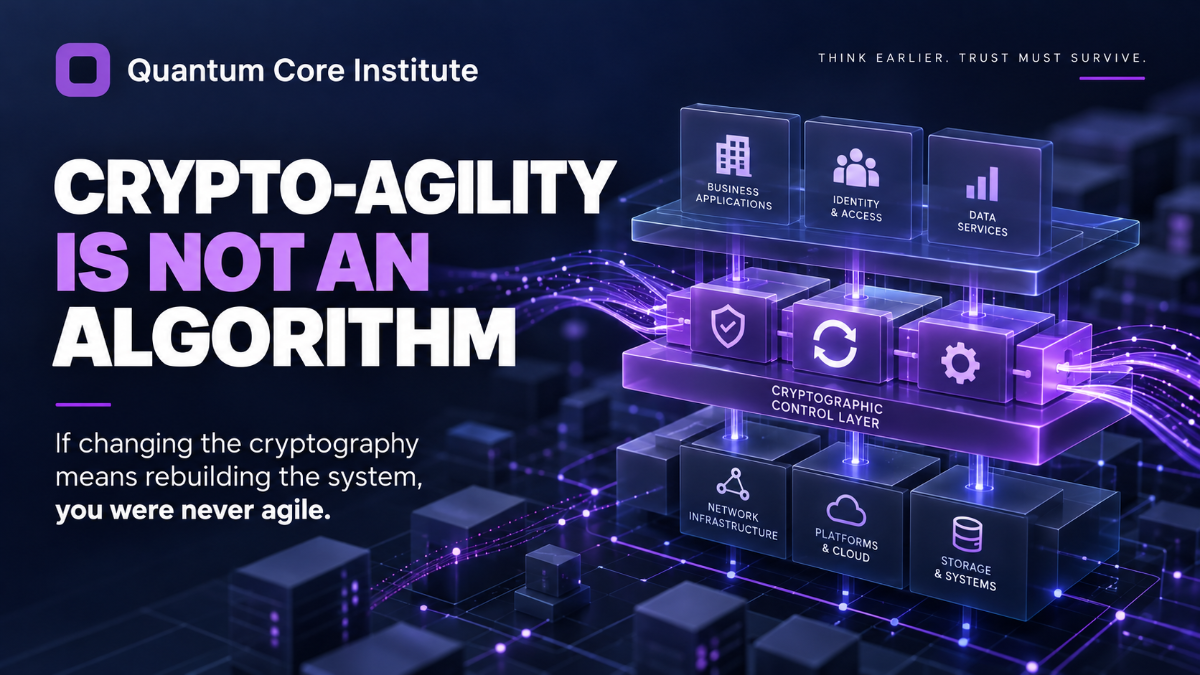
The lesson from Starknet is bigger than Starknet. Crypto-agility is not an algorithm feature. It is an architectural property. An organization can claim to be crypto-agile because one software component supports a new algorithm. That does not mean the organization can actually migrate.
What happens if the application can change but the identity provider cannot?
What if the server supports PQC but the certificate infrastructure does not?
What if the organization is ready but its cloud provider, payment processor, device fleet, embedded hardware, or critical vendor is not?
What if changing the cryptography requires changing the customer identity, account number, device, or business process underneath it?
That is where migration becomes expensive.
Starknet’s account-abstraction approach is interesting because it illustrates the opposite model: preserve the identity, change the cryptographic control.
That should be the aspiration far beyond blockchain.
An enterprise should eventually be able to rotate a machine identity from one signature scheme to another without rebuilding the system around it. A financial institution should be able to change the cryptography protecting a payment workflow without changing the payment itself. A software vendor should be able to replace its signing mechanism without redesigning its distribution architecture. A company should be able to migrate cryptography without forcing customers to migrate the business relationship.
That is true crypto-agility.
And it creates an important distinction for QCI-QS1: Quantum readiness is not demonstrated by having a post-quantum algorithm.
It is demonstrated by having an architecture capable of changing cryptographic assumptions without losing identity, continuity, evidence, or trust.
That gives us today’s boardroom question: “If we had to replace one of our critical cryptographic mechanisms tomorrow, what else would we be forced to change with it?”
If the answer is:
- the account,
- the application,
- the vendor,
- the device,
- the customer workflow,
- or the architecture itself,
- then the organization may not yet be crypto-agile.
Starknet is beginning to ask that question at protocol scale. Enterprises should be asking it now.
Think Earlier. Trust Must Survive.