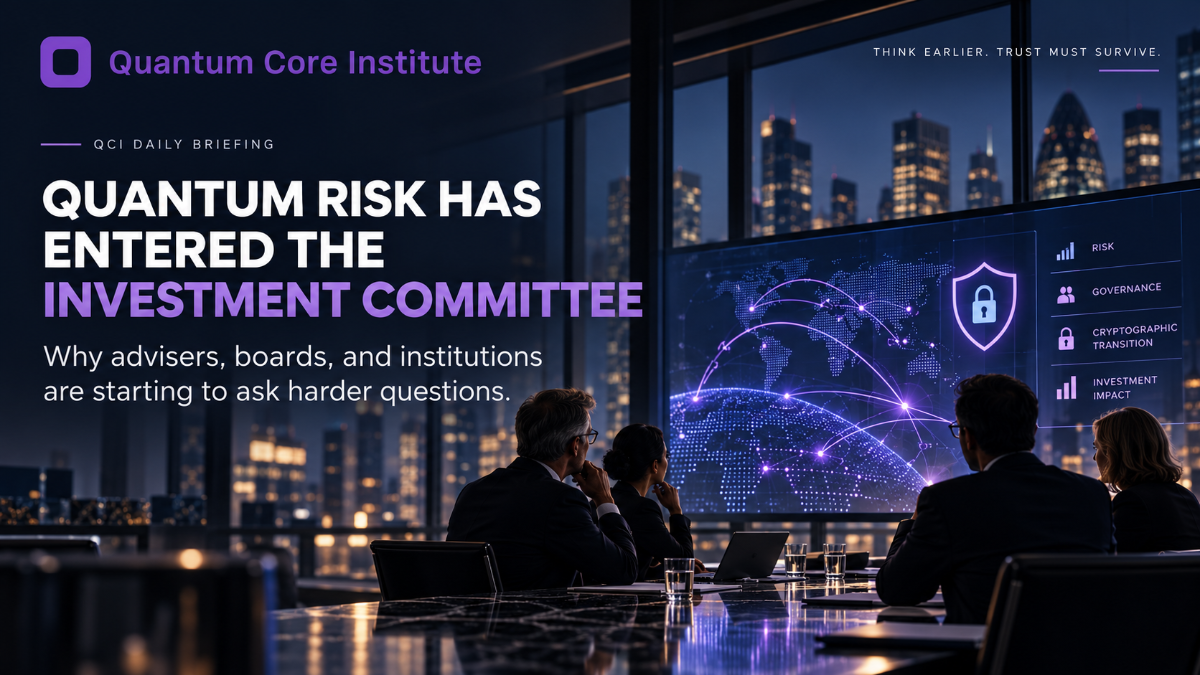
The quantum-readiness conversation may be crossing an important threshold.
It is moving from: technical risk to operational risk to investment risk.
That progression matters.
Once investors, advisers, insurers, regulators, auditors, and boards begin asking about quantum exposure, organizations will need something more defensible than:
“We are monitoring developments.”
They will need to show where vulnerable cryptography exists.
They will need to demonstrate whether keys can rotate.
They will need to understand which assets or systems expose public keys.
They will need to know whether long-lived information creates harvest-now, decrypt-later exposure.
They will need to assess their vendors.
And they will need to show that migration can occur without creating a bigger operational problem than the threat itself.
This is exactly why quantum readiness should be measured, not asserted.
A blockchain saying it is “quantum safe” is not enough.
A custodian saying it has a roadmap is not enough.
A company saying it follows NIST is not enough.
The real question is whether there is evidence.
That is the governance problem QCI-QS1 v2.3 is designed to address.
The framework gives organizations a way to move from cryptographic inventory, to exposure analysis, to Q-Risk scoring, to migration planning, to vendor oversight, and ultimately to board-level evidence of progress.
Because the next group asking about quantum risk may not be cryptographers.
It may be your investors. And when that happens, “we are watching it” will not be a particularly satisfying answer.