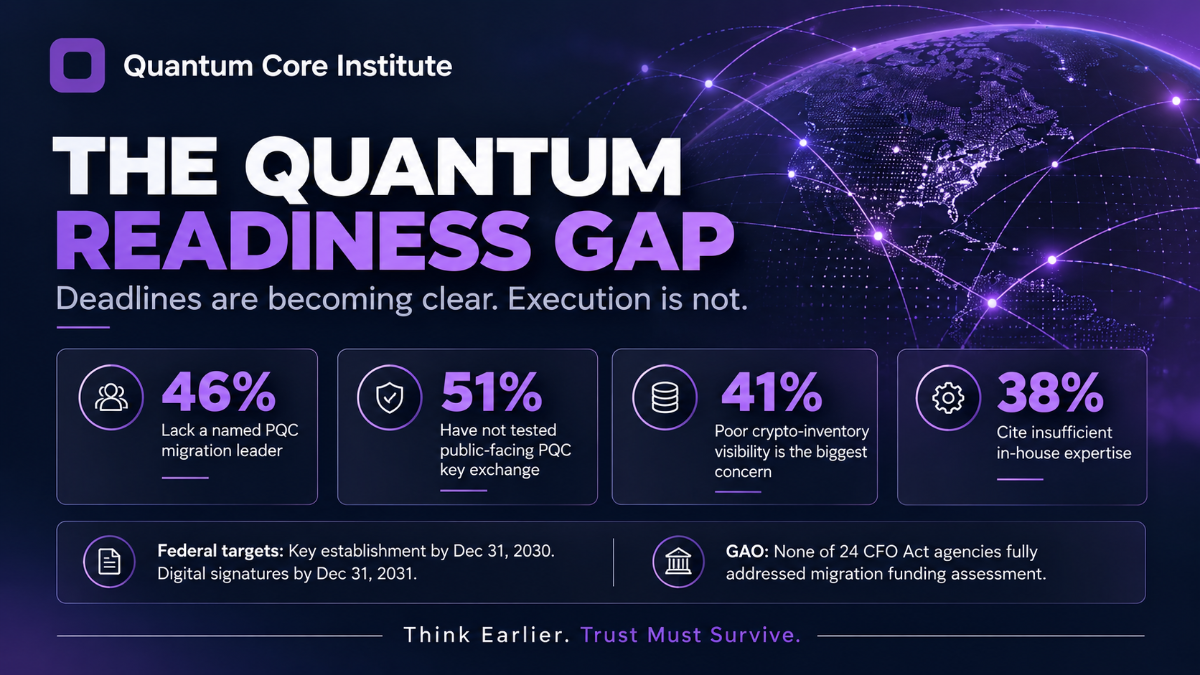
The first signal is the widening gap between policy and operational readiness.
Executive Order 14412, issued June 22, established specific federal migration requirements. High-value and high-impact federal systems are directed to use post-quantum cryptography for key establishment by December 31, 2030, and for digital signatures by December 31, 2031. The order also requires agencies to identify PQC migration leads and directs the federal acquisition process toward post-quantum requirements for covered contractors.
OMB guidance goes further by making clear that this transition is not solely the responsibility of the CIO or CISO. Agencies are expected to integrate PQC migration into existing governance structures, define roles and responsibilities across leadership, build migration plans, and ultimately ensure systems are cryptographically agile.
Then comes the uncomfortable comparison.
GAO’s October report examined all 24 Chief Financial Officers Act agencies and found that none had fully addressed the funding-assessment practice needed for migration. GAO also identified incomplete cryptographic inventories, insufficient expertise, inadequate processes, and a lack of testing in agency environments. It ultimately made 89 recommendations to 23 agencies.
That is the important signal.
The federal government increasingly knows what outcome it wants.
It is still struggling with the operational information required to produce that outcome.
The same issue is appearing in the private sector.
Cisco’s new quantum-readiness guidance makes the point explicitly: resilience belongs to the entire system, not to individual products. Cisco argues that organizations need coordinated strategy across infrastructure, security, products, and partners, and says it plans to enable quantum-safe communications capabilities across most of its core portfolio by December 2026.
That is another sign that the conversation has moved. Post-quantum readiness is no longer simply about selecting ML-KEM or ML-DSA. It is about whether the organization can actually execute the transition.