The important question is not whether crypto is genuinely more quantum ready than traditional finance. We do not yet have enough standardized evidence to make that claim.
The more useful observation is this: Crypto is being forced to confront cryptographic migration as an architectural problem earlier than many traditional organizations are.
That may give it an advantage.
When money can disappear permanently because of a key failure, cryptographic assumptions receive unusually intense scrutiny.
Traditional organizations often have more buffers.
- Contracts.
- Insurance.
- Centralized account recovery.
- Fraud reversal.
- Administrative controls.
Legacy systems that can continue operating despite technical debt. Those buffers are valuable. But they can also allow cryptographic migration to remain invisible for longer.
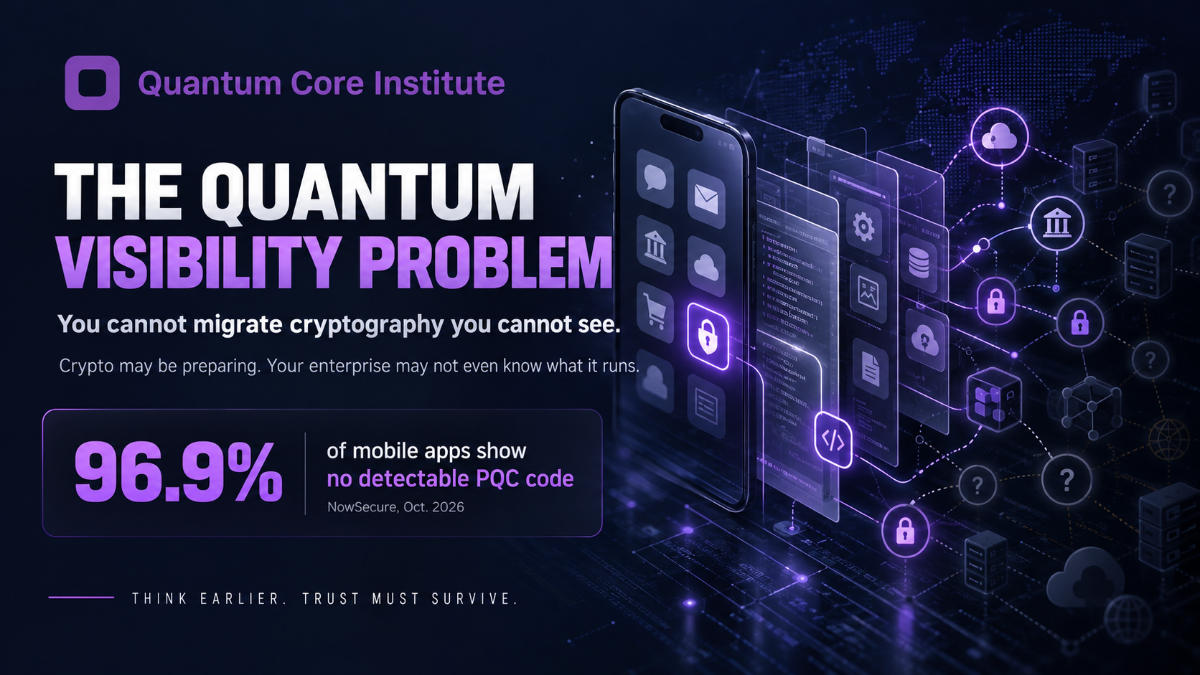
The NowSecure findings illustrate the problem.
If an organization cannot identify which cryptographic libraries exist inside 100 mobile applications, how confidently can it claim to have a post-quantum migration plan?
If it cannot identify third-party SDK dependencies, how does it know which suppliers determine its migration timetable?
If authentication, certificates, machine identities, mobile APIs, embedded libraries, and backend services all change on different schedules, who actually owns the transition?
This brings us back to the recurring QCI-QS1 question:
Can the organization change its cryptography deliberately when the assumptions change?
Not just on a server.
Across applications.
Across identities.
Across vendors.
Across mobile devices.
Across infrastructure.
Across the entire trust chain.
That is crypto-agility.
And today’s market signals suggest something uncomfortable.
The organizations most exposed to the quantum transition may not be the ones using the weakest cryptography. They may be the ones with the weakest visibility.
So the boardroom question for today is: “If 97% of mobile applications show no detectable PQC code, do we actually know what cryptography our own applications depend on?”
If the answer requires someone to go find out, that is the beginning of the inventory. And perhaps the beginning of quantum readiness.
Think Earlier. Trust Must Survive.