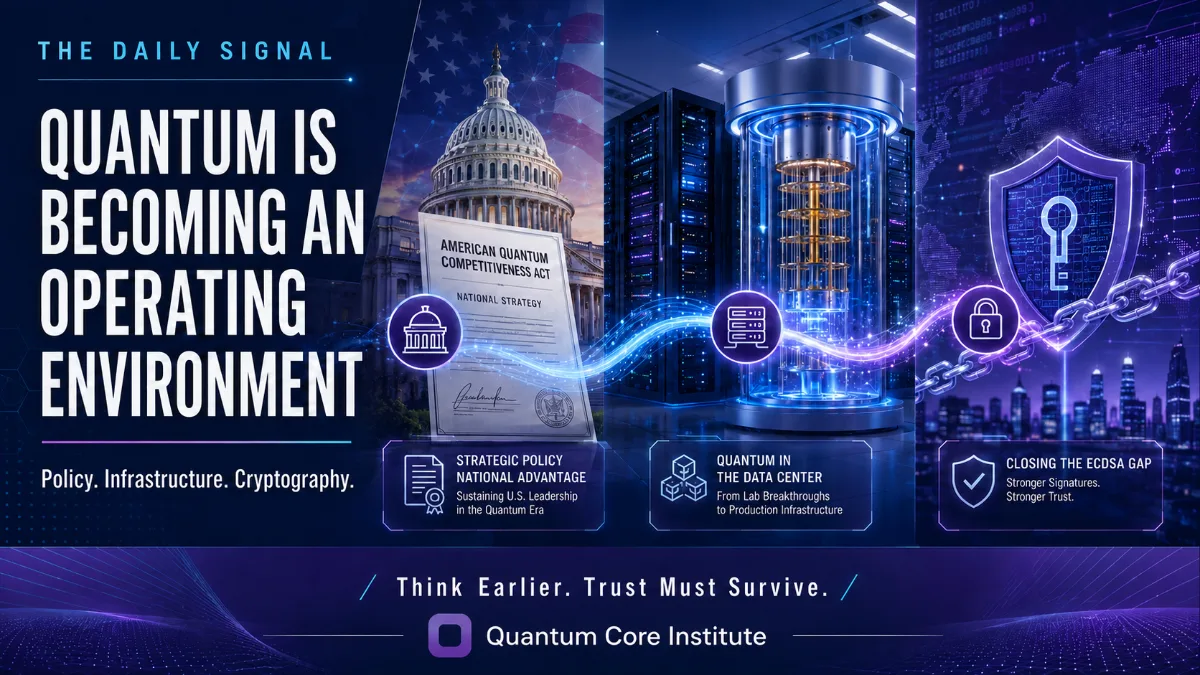
Organizations should start looking for evidence that quantum is entering their operating environment, even if they have no intention of buying a quantum computer.
Look at the infrastructure you depend on. Are cloud, data-center, security, identity, financial, semiconductor, or communications vendors beginning to change their architectures or roadmaps because of quantum?
Look at your regulatory environment. Are governments treating quantum primarily as research, or are they beginning to address commercialization, supply chains, security, and deployment?
Look at your cryptographic dependencies. Are the assumptions behind your migration timetable still based on hardware estimates from several years ago, or are you tracking changes in both quantum capability and attack efficiency?
And look at your governance model. Who inside the organization is responsible for recognizing when these external signals collectively become an internal risk decision?
That is the point where quantum intelligence becomes quantum readiness.
The most important quantum milestone this week may not be a qubit count. It may be the fact that quantum is beginning to look ordinary.
- A machine goes into a commercial data center.
- A congressional bill discusses manufacturing and trusted supply chains.
- A major payments company begins publicly modeling the narrowing gap around a widely used digital signature scheme.
None of these events means Q-Day has arrived.
Together, they tell us something more useful:
The environment around Q-Day is already being built.
Organizations that wait for one unmistakable technological breakthrough may miss the much earlier transition taking place around them.
The better strategy is to watch when infrastructure, markets, policy, and security behavior begin moving in the same direction.
They increasingly are.
Think Earlier. Trust Must Survive.