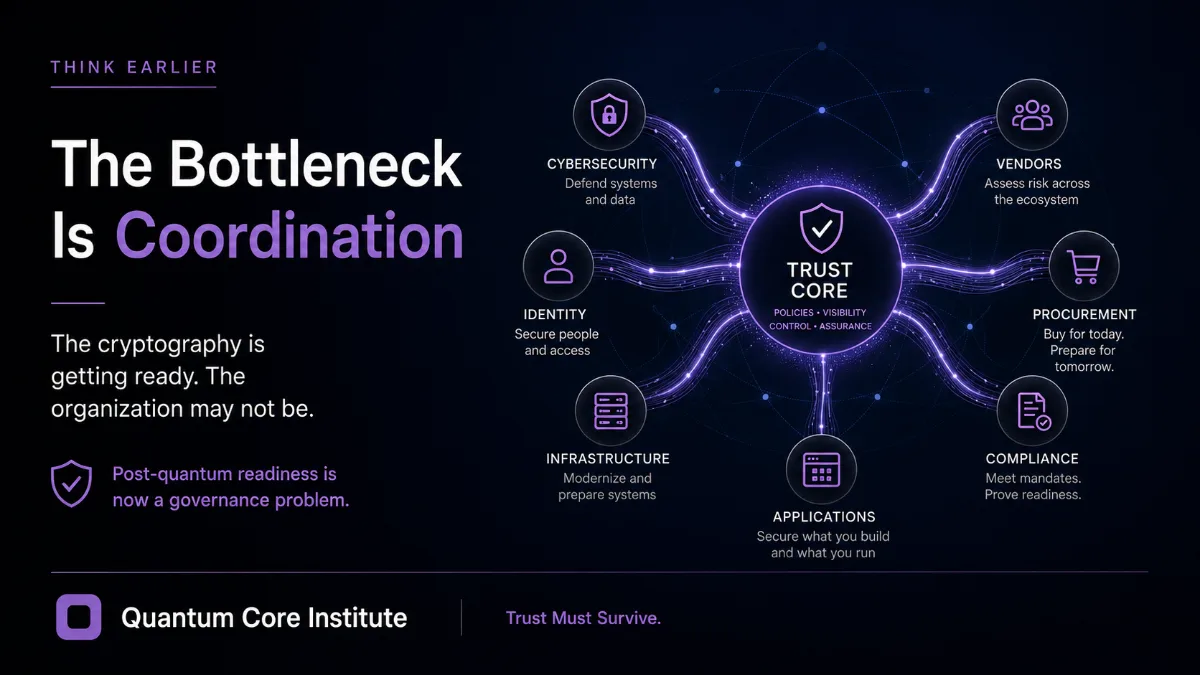
For years, organizations had a convenient reason to wait. The standards were not finished. That excuse is disappearing.
NIST standardized its first post-quantum cryptographic algorithms in 2024. Organizations now have defined technical options for replacing vulnerable public-key cryptography. But choosing an algorithm is only a fraction of the migration.
Cryptography sits inside applications, identity systems, certificates, hardware, cloud services, vendor products, APIs, payment infrastructure, embedded devices, and software nobody particularly wants to touch.
Replacing it requires people who rarely operate as one team. Cybersecurity has part of the problem. Infrastructure has another. Identity teams have another. Procurement inherits the vendor dependencies. Legal and compliance inherit the deadlines. And eventually someone has to decide who owns the transition.
Nature's argument is therefore more consequential than it first appears. The technical question is becoming easier to answer. The organizational question is not.
This is also not a new concern appearing from nowhere. A 2022 Nature perspective warned that billions of existing and future devices would need to transition to post-quantum cryptography and described the process as potentially spanning decades.
Four years later, standards are further along. The coordination problem remains.