ISSUE #162 Quantum Core InstituteStrategic Intelligence on the Future of Quantum Risk Having trouble viewing this email? View it in your browser |
Quantum value is moving from theory into operational claimsJuly 29, 2026 |
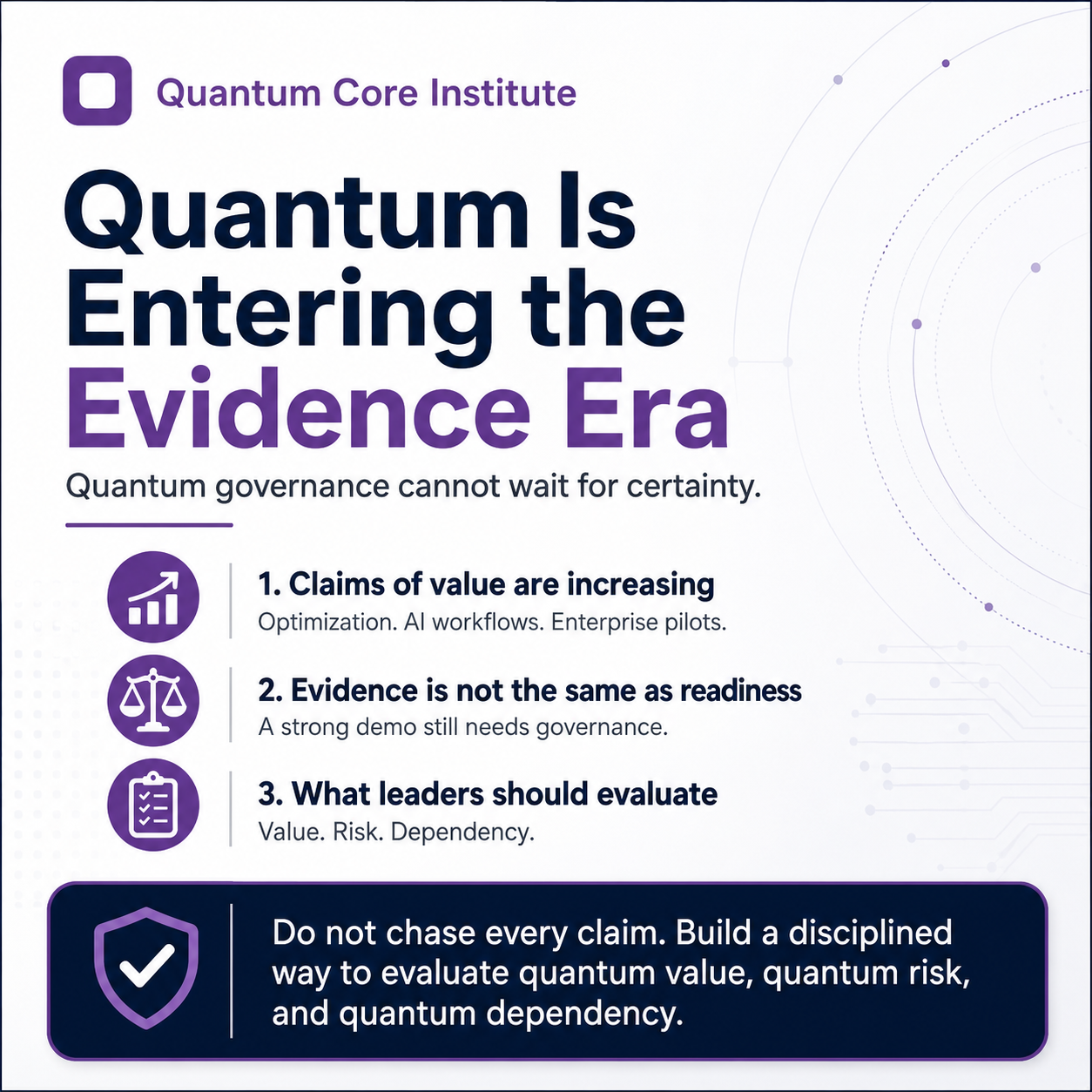
Opening OrientationToday’s quantum news is useful because it shows the field being pulled in two directions at once. On one side, we are seeing stronger claims of near-term business value. AT&T and D-Wave are pointing to a network optimization workload reportedly accelerated from roughly an hour to under 15 seconds. Quantinuum and NVIDIA are validating a generative quantum AI framework for pharmaceutical research. Quantum neural networks are being tested on real hardware. Infleqtion is adding senior leadership around quantum computing systems. These are not abstract “someday” stories. They are efforts to connect quantum systems to actual operational problems. On the other side, the underlying science and engineering remain complex. Nature is publishing work on non-Hermitian edge and cluster bursts on digital quantum processors. Researchers are still building tools for quantum physics research. Quantum neural networks are not yet mature production tools. Quantinuum’s upcoming financial reporting will likely give the market another chance to test whether quantum companies can turn technical progress into commercial evidence. That is the signal for today: quantum is being forced into the evidence era. For enterprises, this is the messy middle. Quantum is no longer easy to ignore, but it is not yet simple to adopt. The smart posture is not hype and not denial. It is disciplined evaluation. |
Signals We Are WatchingThe first signal is that quantum optimization is starting to look more operational. AT&T’s reported use of D-Wave to cut a network optimization task from about an hour to under 15 seconds is exactly the kind of story executives understand. Network operators constantly deal with routing, congestion, capacity, configuration, and resource-allocation problems. If quantum or quantum-hybrid methods can materially improve even narrow classes of these problems, that moves the conversation from theoretical possibility to operational testing. But this kind of claim needs careful governance. A 240x acceleration sounds impressive, and it may be. The practical questions still matter: What was the classical baseline? Was the workload representative of production complexity? Was the result repeatable? What integration cost was required? What data moved to the vendor environment? What happens when the workload changes? The headline is useful, but the governance work begins after the headline. The second signal is that quantum and AI are becoming increasingly intertwined. Quantinuum and NVIDIA’s work on a generative quantum AI framework for pharmaceutical research points toward a future where quantum systems are not standalone replacements for classical systems. They are components inside hybrid workflows. In pharma, chemistry, materials science, and optimization, the likely path is not “quantum replaces everything.” It is more likely that quantum capabilities get inserted into specific steps where classical methods struggle. That matters because AI already has executive attention, budget pressure, data governance concerns, and infrastructure constraints. If quantum enters through AI workflows, it may bypass the formal “quantum strategy” conversation entirely. It may show up as a research partnership, an optimization tool, a model-training experiment, a simulation workflow, or a vendor feature. That creates a governance issue. Someone must decide which quantum-AI experiments are allowed, what data they can use, how results are validated, and when an experiment becomes a dependency. The third signal is that quantum neural networks are getting a hardware reality check. For years, quantum neural networks have lived largely in the realm of theory, simulation, and expectation. Testing them on actual quantum-computing architectures is important because hardware reveals what theory can politely avoid: noise, scale limits, error behavior, circuit depth, latency, and repeatability. This is a healthy development. The field needs fewer broad promises and more controlled comparisons. Organizations should watch this space, but not confuse early hardware tests with enterprise readiness. The question is not whether quantum neural networks are interesting. They are. The question is whether they can outperform well-optimized classical approaches for specific workloads, at acceptable cost, with explainable performance, reliable tooling, and manageable governance. That bar is higher than a good demo. The fourth signal is that commercial quantum companies are being pushed to prove operational credibility. Quantinuum’s financial reporting, D-Wave’s market reaction, and Infleqtion’s leadership appointment all point to the same market pressure. Investors, customers, and partners are beginning to ask whether quantum companies can move from technical narrative to deployable systems, repeatable use cases, revenue growth, and long-term support. That matters for enterprise buyers. Vendor viability is part of quantum governance. If a bank, hospital, utility, manufacturer, or government contractor begins depending on a quantum-enabled platform, it needs confidence that the vendor can support the system over time. A clever algorithm is not enough. The vendor needs documentation, integration support, security controls, financial durability, roadmap clarity, and evidence that the capability can survive outside the lab. |
What This All MeansQuantum is entering a new phase where claims of value will become more specific, more testable, and more commercially charged. That is good news. The industry needs evidence. Enterprises need use cases that can be evaluated against classical baselines. Governments and investors need to know which architectures, vendors, and platforms can move from promise to operations. Boards need to understand whether quantum is a future opportunity, a present dependency, a security risk, or all three. But the evidence era also creates a new risk: premature confidence. A successful optimization demo does not mean quantum is broadly ready. A promising quantum-AI framework does not mean pharmaceutical R&D has been transformed. A hardware test of quantum neural networks does not mean enterprise AI workloads should move tomorrow. A market rally does not prove technical maturity. A stock selloff does not prove the technology failed. The practical answer is governance. Organizations should create a repeatable way to evaluate quantum claims. That evaluation should ask what problem is being solved, what classical baseline is being used, what data is required, what vendor dependency is created, what security controls apply, what integration costs exist, what evidence proves the result, and who owns the decision to continue or stop the effort. This is especially important because quantum will often enter through adjacent initiatives. It may appear inside network optimization, AI infrastructure, pharmaceutical research, supply-chain modeling, cloud services, managed security, or vendor platforms. The organization may not see a project labeled “quantum.” It may see a performance improvement, a research partnership, a new feature, or a vendor roadmap. That is exactly how dependencies form before governance catches up. For our audience, the message is straightforward: do not wait for quantum advantage to become settled before assigning ownership. The value side and the risk side are moving at the same time. Quantum may create new opportunities in optimization, simulation, sensing, networking, and AI. It may also create new exposure across cryptography, identity, certificates, software signing, payment workflows, vendor platforms, and long-lived records. Those two realities should be governed together. The best organizations will not be the ones that loudly declare they have a quantum strategy. They will be the ones that can answer practical questions with discipline: - Where could quantum create real business or operational value?
- Which quantum claims deserve pilots, and which deserve polite skepticism?
- Which vendors are shaping our exposure?
- Which workloads, data sets, and systems are involved?
- Which trust systems must remain secure over time?
- Who owns the decision when experimentation becomes dependency?
Quantum risk starts before quantum advantage. And quantum value starts before broad adoption. Both require governance before they require certainty. |
📬 Share This NewsletterKnow someone who would benefit from this? Forward this email or share the link below. |
Quantum Core Institute Strategic Intelligence on the Future of Quantum Risk
© 2026 Quantum Core Institute. All rights reserved. Washington, DC You're receiving this email as part of our Quantum Core Institute community, which includes subscribers and professionals we've connected with regarding quantum computing strategies. |
|