ISSUE #163 Quantum Core InstituteStrategic Intelligence on the Future of Quantum Risk Having trouble viewing this email? View it in your browser |
Quantum is becoming a manufacturing and integration raceJuly 30, 2026 |
Opening OrientationToday’s quantum news points to a major shift in the market: quantum is becoming less of a pure research race and more of an industrial integration race. IonQ receiving regulatory approval to complete its acquisition of SkyWater Technology is one of the clearest signals. The strategic logic is not just “another quantum company bought another asset.” It is that IonQ wants more control over the manufacturing stack, supply chain, and hardware development path. Reuters previously reported that IonQ’s planned $1.8 billion acquisition would bring semiconductor manufacturing capabilities in-house, while IonQ described the move as part of creating a vertically integrated full-stack quantum platform. At the same time, silicon-based quantum processors are gaining attention because they connect quantum ambitions to the existing semiconductor ecosystem. Recent work on a digitally controlled silicon quantum processing unit argues that commercially relevant quantum computers will need qubits that can be manufactured, integrated, and controlled at scale. That language matters. It moves the conversation away from “can we make qubits?” and toward “can we manufacture, control, wire, cool, operate, and scale them reliably?” That is the signal today. Quantum is not only asking for scientific proof. It is asking for industrial discipline. |
Signals We Are WatchingThe first signal is vertical integration. IonQ’s SkyWater move should be read as a supply-chain and manufacturing-control signal, not merely a corporate transaction. Quantum companies are starting to recognize that the road to scalable systems may depend on controlling more of the stack: fabrication, components, packaging, hardware development, integration, and customer delivery. For enterprise buyers, this raises a governance question. If quantum vendors become vertically integrated platform companies, their roadmaps may influence not only the technology organizations adopt, but also the supply-chain dependencies they inherit. The second signal is silicon’s growing importance as a scaling story. Silicon matters because it connects quantum development to existing semiconductor manufacturing logic. That does not mean silicon automatically wins. It does mean the market is looking for quantum approaches that can borrow from mature chipmaking capabilities, manufacturing repeatability, and integration pathways. A digitally controlled silicon QPU with cryogenic control, dense wiring, and integrated device performance is not just a physics result. It is a hint that scalable quantum may depend as much on engineering architecture as on qubit physics. The third signal is that quantum integration with high-performance computing and AI is becoming a serious architecture discussion. Argonne’s focus on moving from AI supercomputers to quantum supercomputers, along with broader work on quantum-integrated high-performance computing, points toward a future where quantum systems operate as part of hybrid compute environments rather than standalone machines. That has immediate governance implications. Hybrid systems create questions about data movement, workload orchestration, cloud access, vendor lock-in, latency, security boundaries, validation, and who owns the decision when a research workflow becomes an operational dependency. The fourth signal is vendor maturity. Q-CTRL’s emphasis on real quantum integrations and customer value reflects a broader market shift. Quantum progress is increasingly being measured by deployability, usability, workflow integration, and evidence of customer value. This is healthy. It forces the sector to move beyond headline claims and toward operational proof. But it also requires enterprises to get sharper. A vendor saying “we integrated quantum into a real workflow” is not enough. Leaders still need to know what the baseline was, what data was used, what dependency was created, whether the result is repeatable, and whether the organization can exit if the capability does not scale. The fifth signal is architectural diversification. The news flow includes phononic links, silicon processors, diamond and other qubit approaches, quantum networking concepts, and quantum-classical orchestration. This means organizations should not expect one simple quantum roadmap. The sector is still exploring many ways to scale, connect, correct, and deploy quantum systems. That uncertainty does not justify waiting. It means governance needs to be architecture-aware without being architecture-dependent. In plain English: do not bet the enterprise on a single vendor narrative, but do build the organizational muscle to evaluate the narratives. |
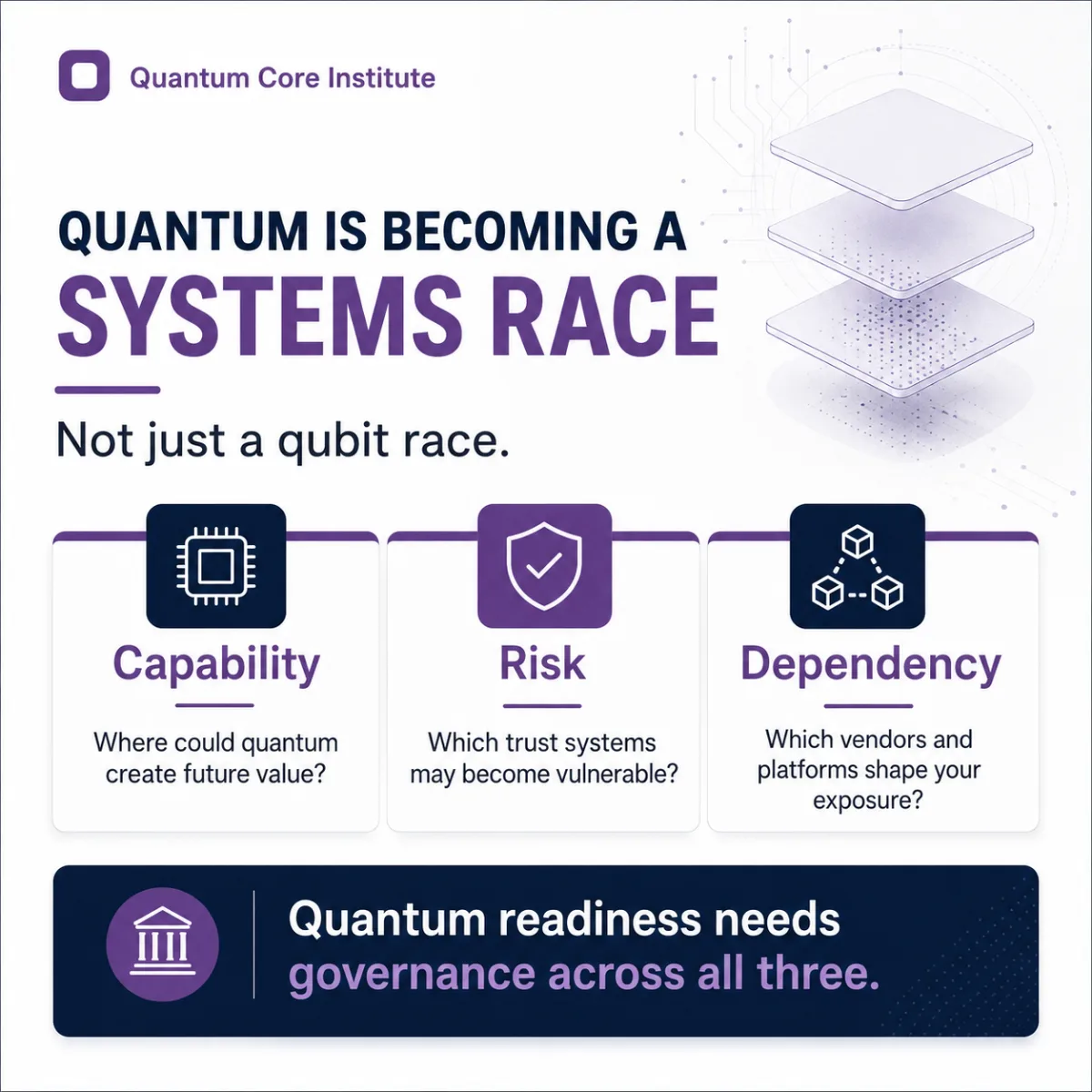
What This All MeansThe most important quantum question for executives is changing. It is no longer only, “When will quantum computers become powerful enough?” It is also, “Who controls the infrastructure that will make quantum useful, scalable, and deployable?” That includes fabrication, supply chains, cryogenic systems, control electronics, networking, software orchestration, cloud platforms, AI integration, security tooling, and vendor support models. Quantum is becoming a system-of-systems problem. The companies that succeed may not be the ones with the single most impressive component. They may be the ones that can integrate fragile pieces into reliable platforms customers can actually use. For QCI’s audience, that has a direct governance implication. Quantum readiness cannot be managed only as a cryptographic migration. It also has to be managed as a dependency strategy. Which vendors control your exposure? Which cloud platforms will introduce quantum or post-quantum features into your environment? Which suppliers are tied to quantum hardware, chips, sensing, or networking roadmaps? Which systems will need crypto-agility because they may operate beyond current standards? Which executives own the decision when quantum moves from pilot to dependency? This is especially relevant for regulated sectors such as credit unions, state banks, healthcare, utilities, government contractors, and infrastructure operators. These organizations may not buy quantum hardware directly, but they will be affected by vendors that do. They may not run quantum workloads internally, but their cloud, security, payment, identity, network, or software providers may integrate quantum or post-quantum capabilities into the platforms they depend on. That is why the right governance model separates quantum into three tracks. The first track is capability. Where could quantum computing, sensing, networking, or simulation create future value? The second track is risk. Which data, signatures, certificates, identities, payment workflows, software updates, and trust systems may become vulnerable over time? The third track is dependency. Which vendors, cloud providers, managed services, suppliers, platforms, and infrastructure partners are already shaping the organization’s exposure? The danger is not only that quantum arrives faster than expected. The danger is that the ecosystem around quantum matures faster than organizational governance. A vendor acquisition can reshape the supply chain. A silicon QPU result can shift investor and government attention. A hybrid computing framework can change how quantum enters enterprise architecture. A customer-value integration can become the seed of a future dependency. A cloud provider’s roadmap can become an organization’s roadmap before the board ever discusses quantum. Quantum risk starts before quantum advantage. Today’s signal is clear: the race is moving from qubits to systems. And systems without governance become dependencies someone else controls. |
📬 Share This NewsletterKnow someone who would benefit from this? Forward this email or share the link below. |
Quantum Core Institute Strategic Intelligence on the Future of Quantum Risk
© 2026 Quantum Core Institute. All rights reserved. Washington, DC You're receiving this email as part of our Quantum Core Institute community, which includes subscribers and professionals we've connected with regarding quantum computing strategies. |
|