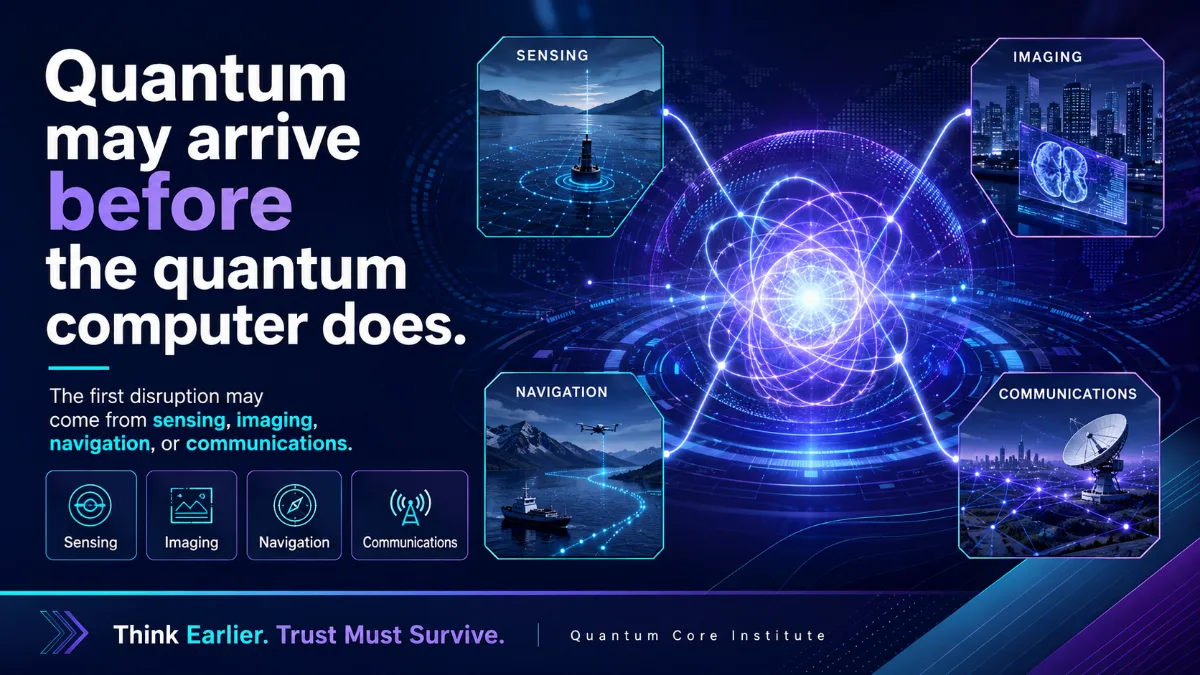
Ask one question:
Where could quantum technology change our environment before quantum computing changes our business?
For a defense organization, that might be sensing, navigation, reconnaissance, or imaging. For healthcare, it could be measurement and imaging. For financial services, cryptographic migration may still dominate. For utilities and infrastructure operators, sensing, timing, communications, and security may intersect.
Then look outside the organization.
Which vendors are introducing quantum-enabled capabilities?
Which competitors are testing them?
Which government programs are funding deployment?
Which technologies could alter assumptions about detection, precision, verification, or security?
Quantum readiness should not begin with a single prediction about when the quantum computer arrives. It should begin with understanding which quantum technologies could reach your operating environment first.
For years, the quantum conversation has been organized around one machine.
That may have been convenient. It was never the whole story.
Diffraqtion is interesting because its technology does not need to wait for the quantum-computing timeline. Strategic investors are funding deployment. Government agencies are testing applications. A flight demonstration is being planned.
At the same time, companies such as S-Transistors are working on the control infrastructure needed to scale cryogenic quantum computers, another reminder that the broader quantum ecosystem is advancing through many interconnected technologies rather than one dramatic breakthrough.
The executive mistake would be waiting for one unmistakable "quantum moment."
There probably will not be one.
Quantum capability is more likely to arrive incrementally, through systems that become useful before most organizations realize they have crossed the threshold.
Think Earlier.
Trust Must Survive.