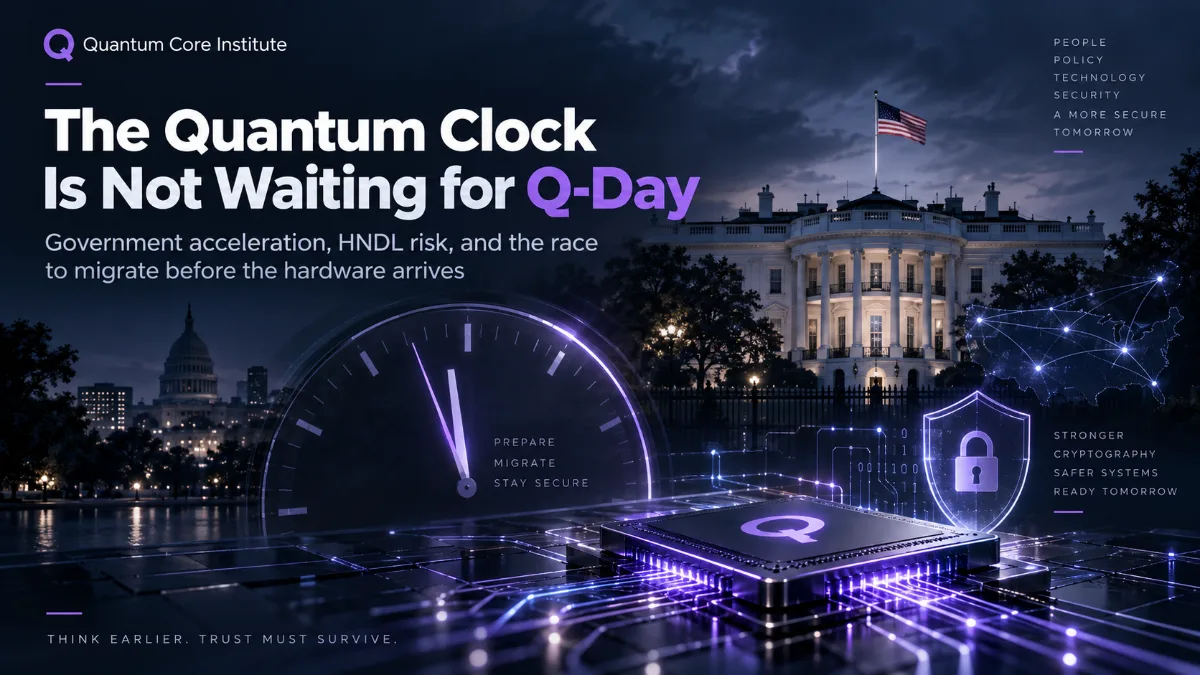
The mistake would be to interpret the DOE announcement as proof that “Q-Day” has suddenly moved to 2028. It has not.
DOE is pursuing a scientifically relevant fault-tolerant quantum computer. That is not the same thing as demonstrating a machine capable of breaking RSA or elliptic-curve cryptography at operational scale.
But the opposite mistake may be more consequential.
Organizations should not require certainty about Q-Day before beginning readiness work.
The government is investing in accelerating the numerator. Quantum capability.
Technology providers are beginning to improve the denominator. The time required to deploy post-quantum protection.
Management therefore needs to understand the space between them.
That means knowing where vulnerable cryptography exists, which data has long confidentiality requirements, which identities and signatures depend on vulnerable algorithms, which third parties create dependencies, which systems cannot be upgraded easily, and who owns the transition.
The question is no longer:
“When will quantum computers break encryption?”
A more useful question is:
“If quantum progress continues faster than our migration progress, which one reaches the finish line first?”
That is a governance question. And unlike Q-Day, organizations can do something about it today.
Think Earlier. Trust Must Survive.