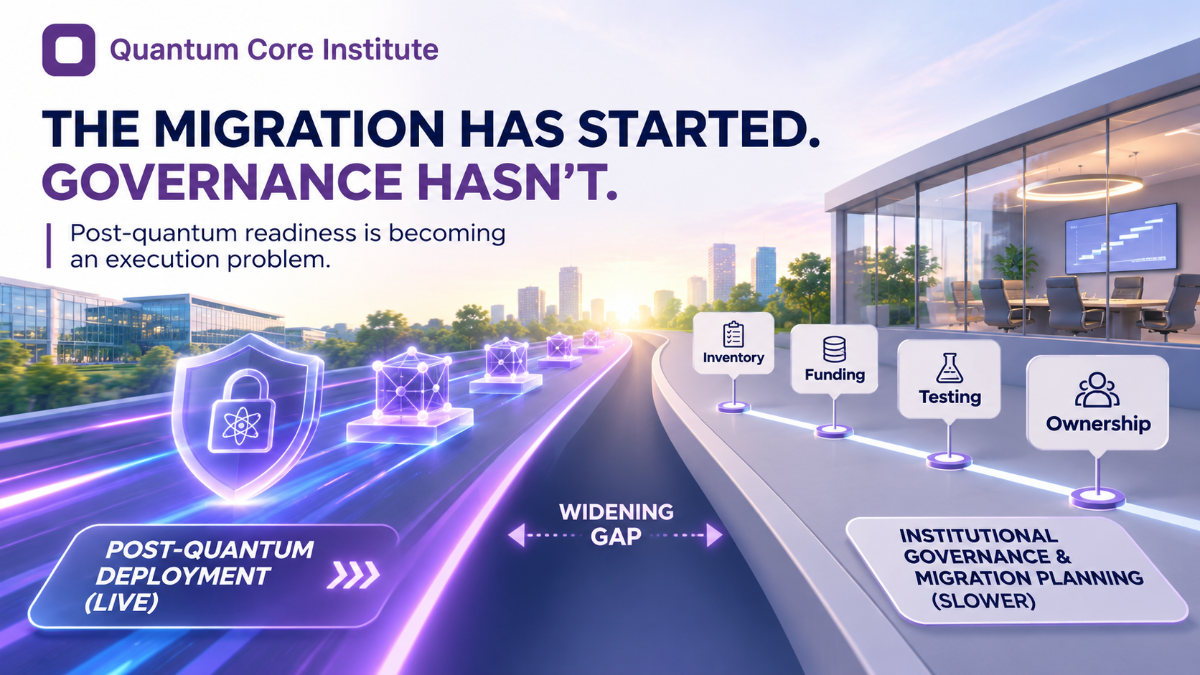
The post-quantum transition is beginning to divide organizations into two very different groups.
One group is experimenting, deploying, measuring, and learning. These organizations are discovering what larger signatures do to performance, how wallets need to change, how custody architectures need to evolve, how hybrid schemes behave, and what users actually experience during migration.
The other group is still trying to determine where vulnerable cryptography exists.
That gap matters because migration knowledge compounds.
An organization that begins experimenting now does not merely become “more secure” today. It begins accumulating operational knowledge about interoperability, performance, vendor support, certificate lifecycles, recovery, testing, procurement, and failure modes. By the time a deadline becomes urgent, that organization may already have years of institutional experience.
An organization that waits does not simply remain where it is.
It falls further behind.
This is why “prepare now” should not be interpreted as a call to replace every cryptographic system immediately. That would be unrealistic and, in many environments, irresponsible. Preparation means building the organizational capability to migrate deliberately when the risk requires it.
That starts with knowing what you have. It requires identifying which systems depend on quantum-vulnerable cryptography, determining which data and identities need the longest protection, understanding which vendors control the migration path, estimating the cost, testing real post-quantum implementations, and determining what evidence will demonstrate that the transition actually worked.
The GAO findings are particularly useful because they reveal what happens when those foundational capabilities are missing. Without an accurate inventory, an organization cannot reliably estimate cost. Without cost information, it cannot budget. Without vendor engagement, it cannot determine whether systems can migrate. Without testing, it cannot know whether the proposed solution will work in its environment.
Each missing piece compounds the others.
That is the accountability gap.
The market increasingly has post-quantum technology to test. What many organizations still lack is the governance machinery required to adopt it.
This should change the boardroom conversation. The question is no longer whether post-quantum cryptography is “ready enough” to deserve attention. There are now enough production deployments, standards, tools, and experiments to begin learning.
The better question is: What has our organization actually tested?
If the answer is nothing, then the organization may not have a post-quantum technology problem yet. It has a preparedness problem, and preparedness is something leadership can address long before a cryptographically relevant quantum computer exists.
Think Earlier. Trust Must Survive.