Organizations need to stop using uncertainty about Q-Day as a reason to delay action.
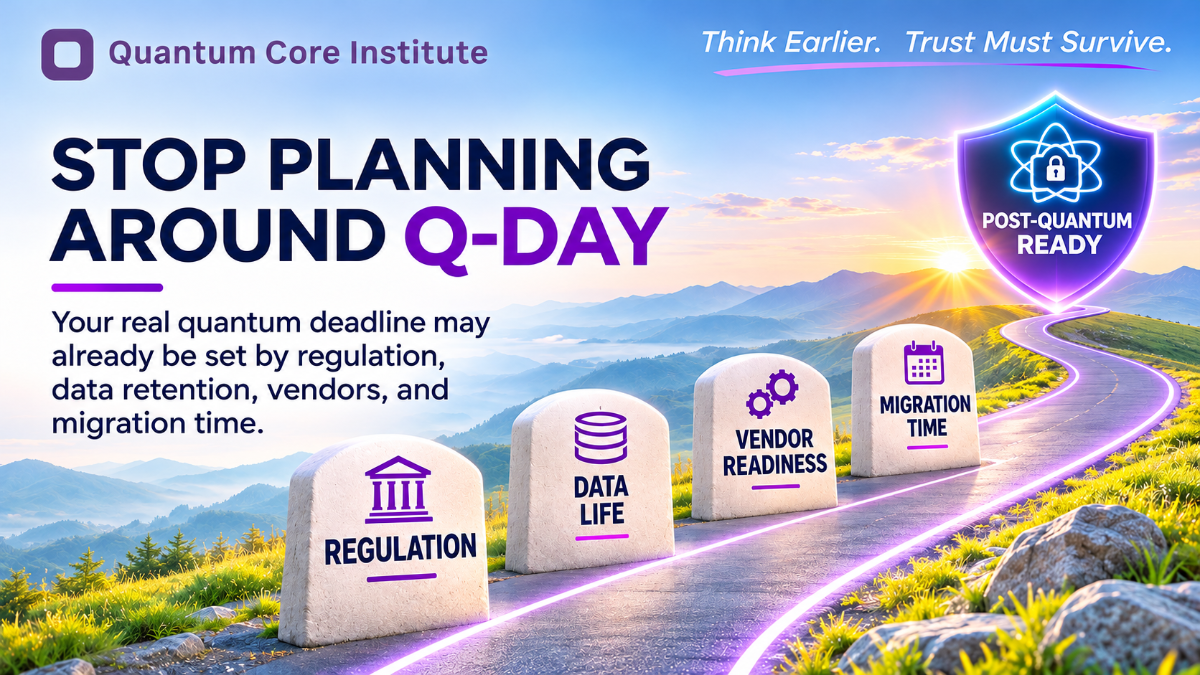
Quantum readiness is increasingly being shaped by deadlines that already exist or can already be calculated. Regulatory requirements provide one set of dates. Data-retention periods provide another. Vendor replacement cycles provide another. Hardware lifetimes, certificate lifetimes, application modernization schedules, and procurement commitments create still more.
Put those together and an organization can begin to identify its real quantum deadline.
That deadline may be different for every system.
Consider a system protecting information that must remain confidential until 2040. If that system still relies on quantum-vulnerable public-key cryptography in 2030, the organization cannot simply say, “We still have five years until 2035.” The data itself may already have created an earlier deadline.
Now add the migration time.
If replacing the cryptography requires an inventory project, procurement cycle, vendor upgrade, hardware replacement, application testing, certificate migration, and production rollout, the transition may require several years.
That is why the phrase “prepare now” can sound unnecessarily alarmist when it is presented as a prediction about quantum hardware.
It becomes much more rational when viewed as a migration calculation.
You do not need to believe that Q-Day arrives in 2029.
You need to know whether a system that takes four years to migrate and protects data valuable for another fifteen years should still be using vulnerable cryptography today.
That is a governance calculation, not a prediction.
It is also why QCI-QS1 v2.3 should continue to emphasize inventory, ownership, migration planning, crypto-agility, supplier dependencies, evidence, and prioritization. A mature readiness program does not ask every system to migrate tomorrow. It determines which systems need to move first and why.
The wrong approach is to create one enterprise-wide countdown to Q-Day. The better approach is to identify multiple quantum deadlines across the organization.
Some will be driven by data longevity. Some by regulation. Some by vendor availability. Some by hardware lifecycle. Some by criticality. Some by the consequences of forged signatures or compromised identities.
That leads to today’s boardroom question:
What date is your organization actually planning against, and why?
If the answer is simply “2035,” the organization may be confusing a standards milestone with its own risk deadline.
If the answer is “we are waiting to see when Q-Day happens,” the organization may not have a readiness strategy at all.
The quantum transition is becoming measurable without knowing the exact date of the quantum breakthrough.
That is the opportunity. Stop trying to predict the machine. Start calculating the migration.
Think Earlier. Trust Must Survive.