The Bitcoin debate exposes a problem that extends far beyond cryptocurrency. Modern digital systems often treat possession of a private key as proof of legitimate authority. If the signature verifies, the transaction is accepted. If the certificate is valid, the software update is trusted. If the machine identity authenticates, the system grants access. If the financial instruction carries the correct credentials, the payment moves.
All of those systems rely on the assumption that the private key is effectively impossible to reconstruct without authorization.
Quantum computing challenges that assumption.
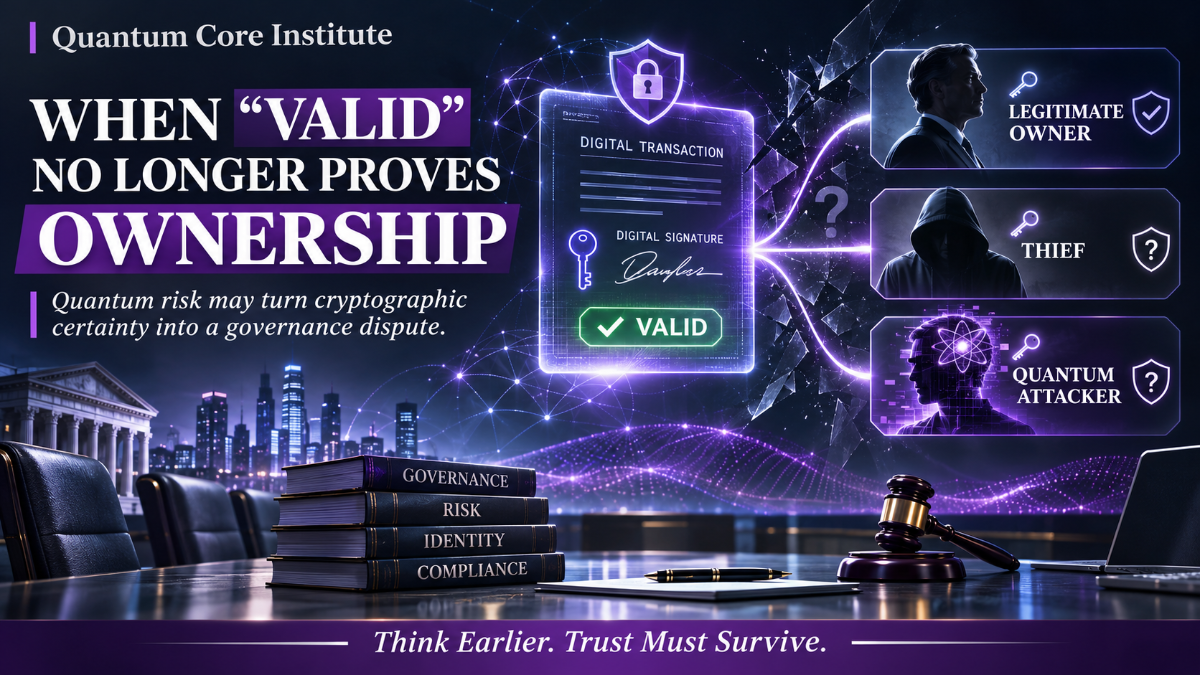
If a private key can eventually be derived from a public key, then the signature may still validate even though the legitimate owner never approved the action. The mathematics can still say yes while the governance context says, “We no longer know who actually authorized this.”
That means quantum readiness has to extend beyond algorithm replacement. Organizations need to think about what evidence survives when cryptographic possession is no longer sufficient. They need recovery processes, secondary authorization, anomaly detection, revocation strategies, key provenance, escalation rules, and clear criteria for when an otherwise valid cryptographic event should no longer be trusted.
This is where the accountability gap becomes especially important. The danger is not only that cryptography might fail. The danger is that cryptography may continue to work exactly as designed while no longer proving what everyone assumes it proves.
That should change the boardroom conversation. Instead of asking only whether the organization can replace RSA, ECC, or a particular certificate, management should be asking whether trust can survive when the assumptions behind those mechanisms become uncertain.
The boardroom question for today is: If a cryptographically valid action could no longer prove legitimate ownership, what evidence would your organization trust instead?
That is not just a Bitcoin question. It is an identity question, a payments question, a software-integrity question, a machine-authentication question, and ultimately a governance question.
The most disruptive quantum event may not be the moment when cryptography visibly stops working. It may be the moment when cryptography keeps working, but no longer proves what we thought it proved.
Think Earlier. Trust Must Survive.