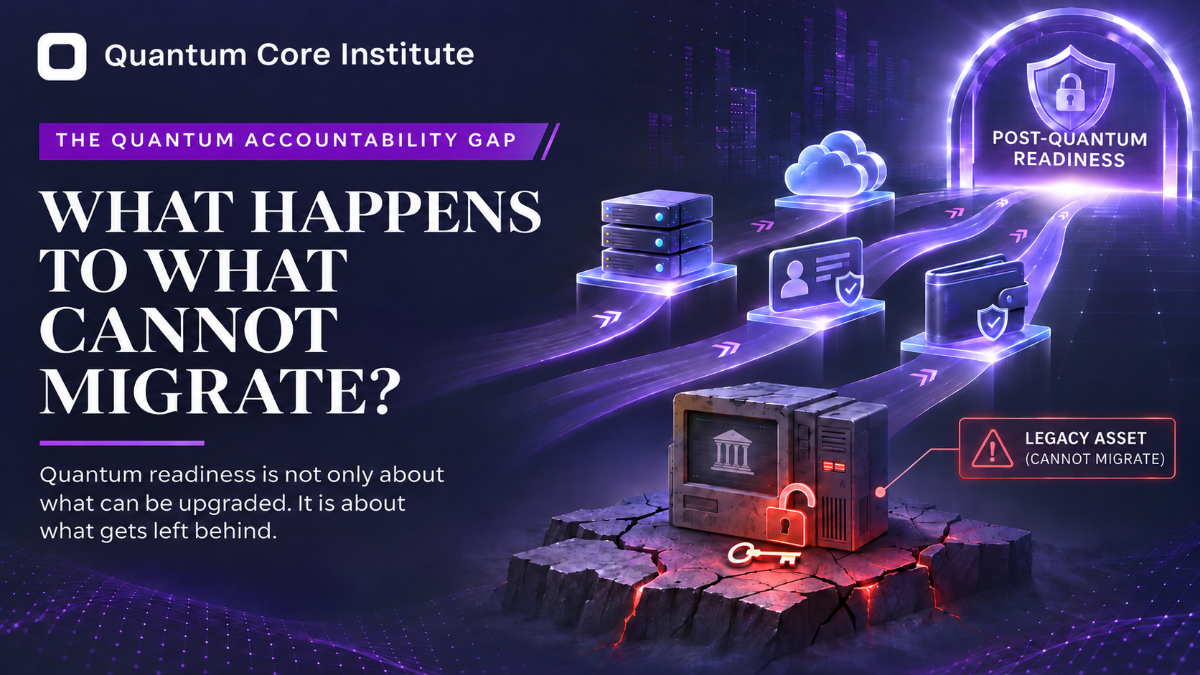
The strongest signal is the growing discussion around proposals such as “Quantum Landmines,” “Staked Auctions,” and other mechanisms recently explored on the Bitcoin developer mailing list. These are early ideas rather than adopted protocol changes, and they should be treated that way. But their existence is important because developers are beginning to explore something more sophisticated than simply declaring vulnerable coins safe or unsafe.
The proposed mechanisms attempt to change the economics of attacking exposed coins. One approach would require anyone spending certain vulnerable outputs to place additional collateral at risk. Another would create mechanisms through which ownership claims could be challenged. Auction-style concepts explore what should happen when coins become vulnerable but no legitimate owner appears to migrate them.
Whether any of these concepts ultimately prove workable is almost secondary. The important signal is that the problem has moved from “Bitcoin needs a post-quantum signature” to “Bitcoin needs rules for what happens when ownership becomes uncertain.”
That is a much harder conversation.
A second signal is the contrast with networks designed around greater cryptographic agility. Starknet continues to attract attention because programmable accounts can potentially change their signature-verification logic without requiring users to abandon the account itself. Falcon-512 experiments and hybrid approaches demonstrate the architectural principle even though broader wallet, custody, bridge, and settlement dependencies remain unresolved.
Algorand, NEAR, Stellar, Bittensor, and other networks are also demonstrating different approaches to introducing post-quantum capabilities. The implementations differ substantially, and a post-quantum feature should never be confused with complete quantum readiness. But collectively these developments highlight an architectural advantage: systems designed to change their cryptography can treat migration as an upgrade problem rather than an ownership crisis.
Bitcoin’s challenge is more difficult because its immutability is one of its defining characteristics.
That creates a paradox. The characteristics that made Bitcoin difficult to change are also the characteristics that make a large-scale cryptographic transition difficult to coordinate.
The third signal is the increasing board-level treatment of quantum risk. Courses, executive briefings, regulatory guidance, and financial-services programs are increasingly framing quantum readiness as a governance, fiduciary, and business-continuity issue rather than something that belongs exclusively to cryptographers.
That is exactly where the discussion needs to go.
The technical community can determine whether Falcon, ML-DSA, hash-based signatures, or another approach satisfies a particular security requirement. But technology cannot determine who should bear the loss when an owner fails to migrate, whether a dormant asset should be protected indefinitely, or whether a network should invalidate an otherwise mathematically valid transaction.
Those decisions require governance.