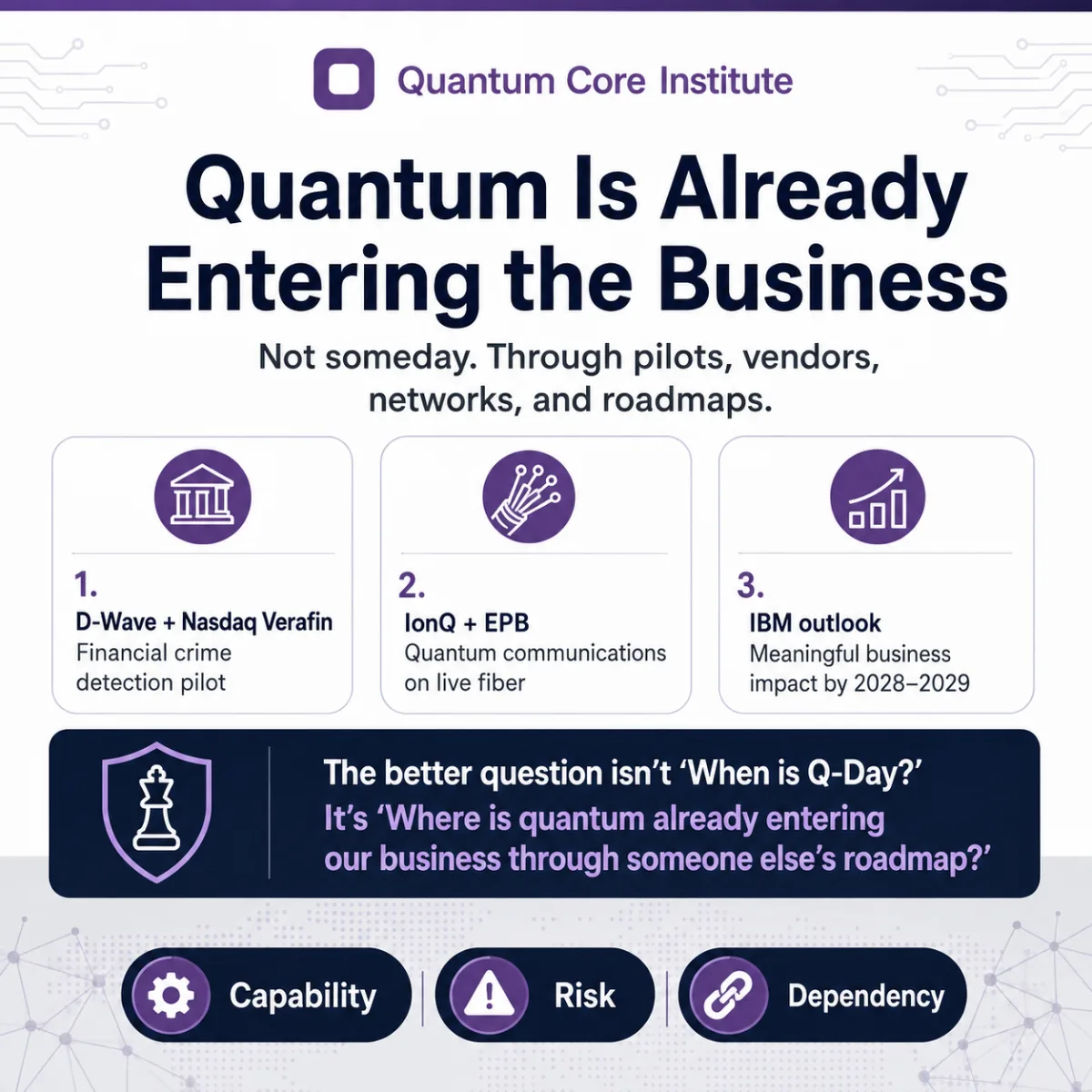
he first signal is financial crime detection. D-Wave and Nasdaq Verafin are aiming quantum-hybrid application development at fraud and financial crime. That matters because fraud detection is already a high-value, data-heavy, machine-learning-driven problem. If quantum-hybrid tools can improve pattern detection, anomaly scoring, or model performance, financial institutions will pay attention quickly.
The second signal is quantum communications entering live infrastructure. IonQ and EPB’s Tennessee Quantum Communications Research Center is important because it moves quantum networking out of pure lab framing and into live fiber context. That does not mean quantum networks are ready for broad deployment. It does mean telecom, utilities, and infrastructure operators should begin watching how quantum memory, fiber networks, secure communications, and operational reliability converge.
The third signal is IBM’s commercial timeline. Arvind Krishna’s comments about quantum becoming meaningful by 2028 or 2029 keep pushing quantum into business-planning territory. Whether that timeline proves accurate is less important than the pressure it creates. Boards will increasingly ask whether quantum is a future capability, a vendor dependency, a risk exposure, or all three.
The fourth signal is that Q-Day remains a mainstream education topic. UT San Antonio’s explainer reinforces that the public conversation is still anchored around the moment quantum computers can break current encryption. That framing is useful for awareness, but incomplete for governance. Q-Day is not when readiness starts. It is when unreadiness becomes visible.