The quantum market is being pulled into a more demanding phase.
For years, the dominant question was whether quantum computers could ever become useful. That question still matters, but it is being joined by more practical questions. Can the systems be manufactured? Can they be integrated? Can they be trusted? Can they be supported? Can customers use them? Can the vendor survive long enough to matter? Can the result beat a classical method in a way that justifies the cost?
That is healthy. The field needs less poetry and more evidence.
But there is a danger in the opposite direction. As the market becomes more skeptical, some leaders may use uncertainty as an excuse to delay all quantum readiness work. That would be a mistake. Skepticism about broad quantum advantage does not erase the need for post-quantum cryptographic planning. Stock volatility does not eliminate harvest-now, decrypt-later risk. A debate over Bitcoin does not remove the need to inventory signatures, certificates, identity systems, software signing, payment workflows, and long-lived records.
The practical governance posture should be balanced.
Organizations should not chase every quantum claim. They should require evidence. They should ask what workload was tested, what classical baseline was used, what cost was included, what data moved, what vendor dependency was created, and whether the result is repeatable.
But organizations also should not dismiss quantum because the field is uneven. They should build readiness around three tracks.
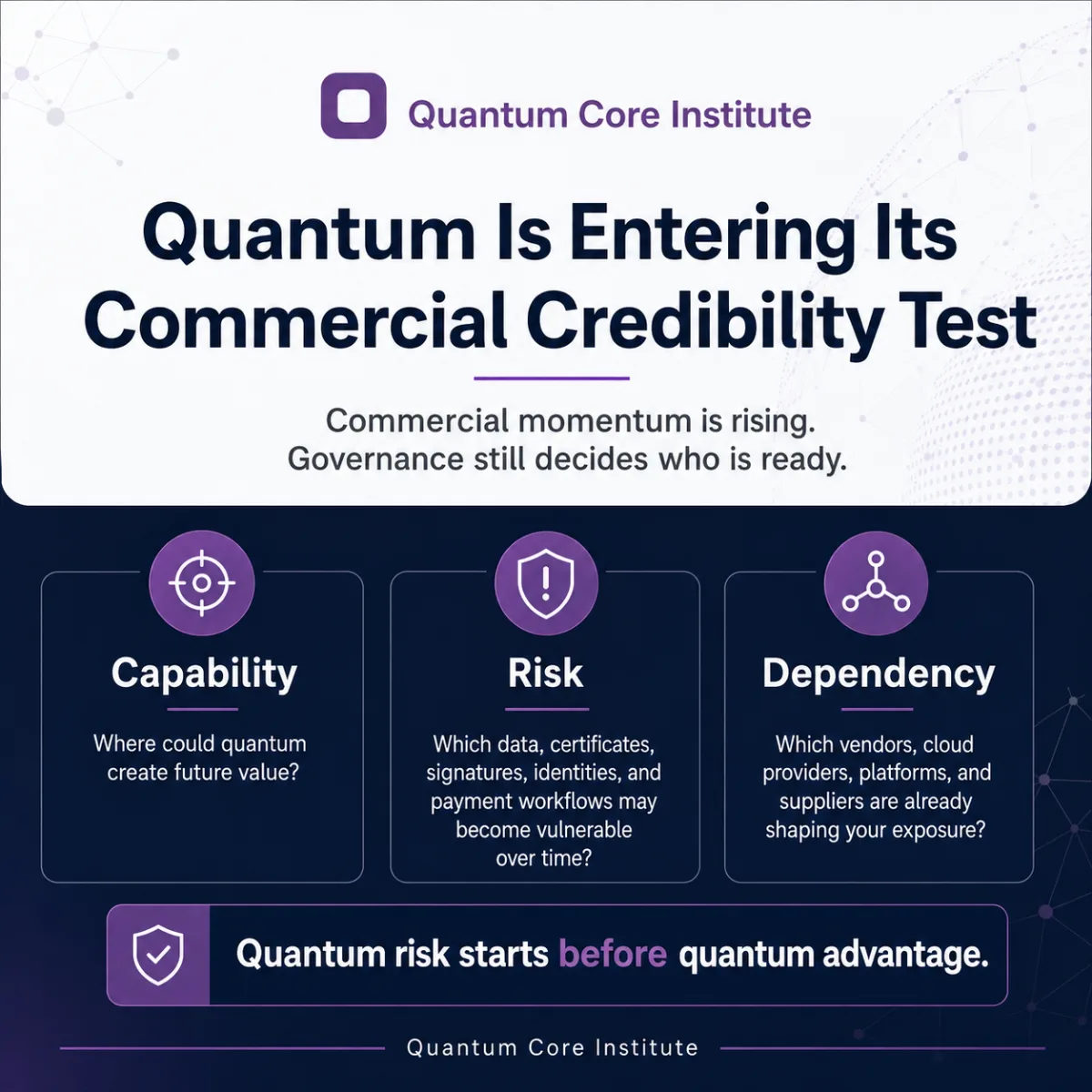
Capability asks where quantum computing, sensing, networking, optimization, or simulation could eventually create value. This helps organizations evaluate opportunities without falling for every shiny claim.
Risk asks which data, certificates, signatures, identity systems, payment workflows, software updates, and trust systems may become vulnerable over time. This keeps the organization focused on long-lived exposure and migration lead time.
Dependency asks which vendors, cloud providers, chipmakers, managed services, suppliers, platforms, and government programs are already shaping the organization’s exposure. This is where many organizations are weakest, because they may not realize that external roadmaps are quietly becoming internal dependencies.
The most important lesson from today’s news is that quantum is no longer a single-track story. It is not only science. It is not only cybersecurity. It is not only investing. It is not only manufacturing. It is not only crypto. It is all of those at once.
That is why quantum readiness needs ownership.
A board does not need to decide today whether IBM, IonQ, D-Wave, Quantinuum, Infleqtion, or some future dark horse will win the market. It does need to know whether the organization has a disciplined way to evaluate claims, protect long-lived trust systems, manage vendor dependencies, and avoid being pulled into quantum decisions without governance.
Quantum risk starts before quantum advantage.
And commercial proof, when it arrives, will not eliminate the need for governance. It will make governance more urgent.