What responsible leaders should notice today Your Quantum Deadline May Be Hiding in Your Data Retention Policy |
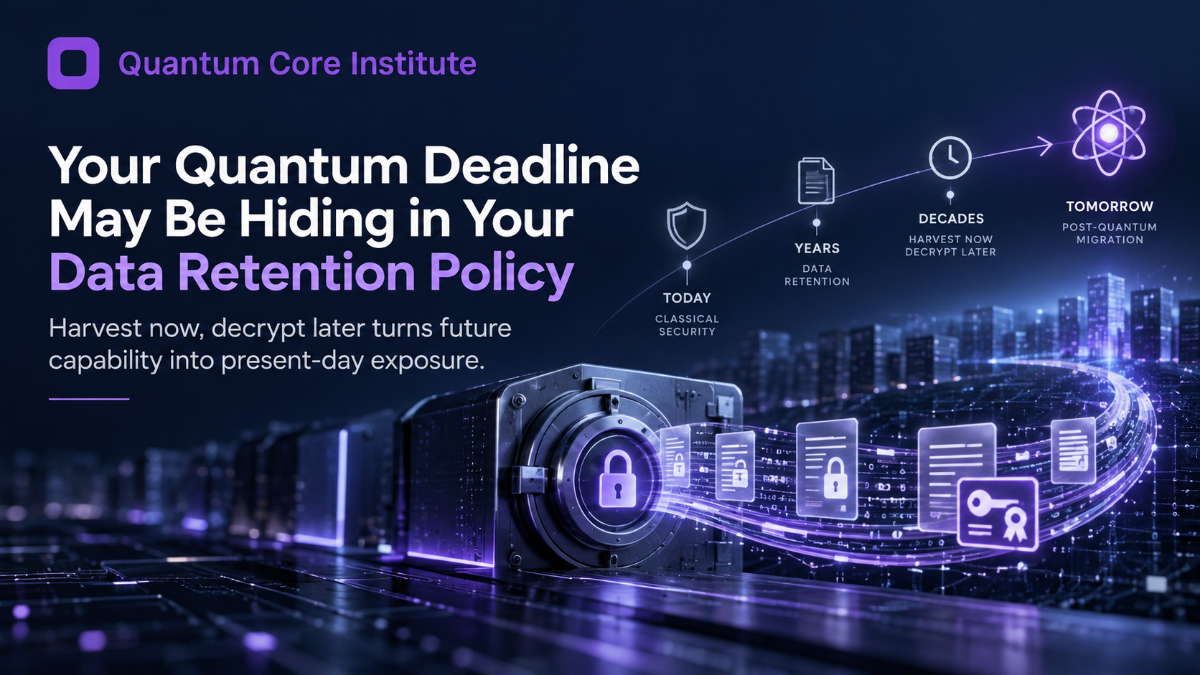
Daily PerspectiveOrganizations still tend to ask the wrong question about quantum risk: “When will a quantum computer be powerful enough to break our encryption?” A more useful question is: “How long must the information we protect today remain confidential?” Those are very different clocks. If an organization holds information that must remain confidential for ten, fifteen, or twenty years, then the quantum threat does not begin on the day a cryptographically relevant quantum computer appears. It begins when an adversary can capture that information and wait. That is the logic behind harvest now, decrypt later. An attacker does not need to break the encryption today. They only need to believe that what they collect today will still have value when the mathematics protecting it becomes vulnerable. For banks, governments, healthcare organizations, defense contractors, infrastructure operators, research institutions, and companies holding valuable intellectual property, that changes the meaning of “future risk.” Future cryptographic capability can create present-day exposure. And that makes data lifespan one of the most important variables in quantum readiness. |
Signals We Are Watching TodayThe most substantive signal continues to be the persistence of the harvest-now, decrypt-later discussion. Posts focused on banking and long-lived enterprise information are making a useful distinction between the lifespan of the data and estimates for quantum hardware. If confidential information must survive longer than the time required to migrate the systems protecting it, waiting for certainty about Q-Day becomes a poor risk strategy. That is why hybrid post-quantum key exchange is increasingly appearing as an early transition mechanism, while authentication, signatures, certificates, identity systems, and broader PKI migration remain more complicated later-stage problems. A second signal is that post-quantum products are increasingly being marketed as the answer. Projects are promoting wallet layers, ML-DSA-based authorization, hash-based signatures, blockchain settlement designs, testnets, and mechanisms intended to make cryptographic upgrades nearly invisible to users. Some of this activity appears to be coordinated marketing rather than independent evidence of adoption, so product claims should be evaluated carefully. The more important signal is the architectural direction. Vendors increasingly understand that successful migration cannot depend on millions of users manually rebuilding how they interact with systems. A third signal is the widening gap between quantum science and quantum-risk management. New hardware architectures, IBM execution controls, quantum sensing initiatives, D-Wave supply-chain work, and other developments continue to demonstrate that the quantum ecosystem is broadening. None of those developments by itself establishes that cryptographically relevant quantum computing has suddenly arrived. But collectively they reinforce a familiar pattern: capability develops across multiple fronts while organizations continue debating when they should begin preparing for one particular consequence. The commercial activity around post-quantum security is another indicator worth watching. Claims involving listed companies, quantum-security products, blockchain projects, and government-related deadlines should be independently verified before being treated as evidence of regulatory requirements. What they do show is that a market is forming around quantum readiness well before the underlying cryptographic threat becomes operational. |
What This All MeansPerhaps the most important quantum metric for an organization is not the number of qubits in somebody else’s laboratory. It may be the number of years its information must remain trustworthy. Consider the equation conceptually: Data lifetime + migration time > time remaining before cryptographic disruption When that becomes true, the organization has a problem. That problem exists even if no quantum computer can attack the data today. And migration time is not trivial. An organization must discover where vulnerable cryptography exists, determine what information depends upon it, prioritize exposures, coordinate vendors, change certificates and keys, update applications and infrastructure, test interoperability, preserve identities and signatures, document the transition, and demonstrate that the new controls actually work. That can take years. This is why crypto-agility matters so much. The organizations best prepared for quantum disruption will not necessarily be those that correctly predict Q-Day. They will be the ones that can change cryptography before they are forced to. Boards should therefore begin asking a different question: Which of our information must remain secure long enough that quantum risk already matters today? That question moves quantum readiness out of the laboratory and into governance. That is where it belongs. Think Earlier. Trust Must Survive. |
The article is not the story. The risk signal is the story. |
📬 Share This NewsletterKnow someone who would benefit from this? Forward this email or share the link below. |
Quantum Core Institute The daily signals that could change trust, risk, and readiness.
© 2026 Quantum Core Institute. All rights reserved. Washington, DC You're receiving this email as part of our Quantum Core Institute community, which includes subscribers and professionals we've connected with regarding quantum computing strategies. |
|
|